The other day we ran across an item in the news about Gesha coffee from Panama. At a recent auction green Gesha coffee beans in Panama went for $13,000 per pound. This is at a time when historically high coffee prices on the NYMEX are flirting with $4 a pound! We know that Gesha is good coffee but really! $13,000 a pound? We hear that such coffee goes for $100 for a cup of brewed Java and a twelve ounce bag can routinely go for more than $40 a pound. This raises the question. Are the most expensive coffees the best coffees for simply those with the greatest hype?
What Is Gesha Coffee?
Gesha coffee comes from Ethiopia from near the Gesha forest where it was discovered in the 1930s. It was being grown in Central America in the 1950s. It is a distinctively sweet Arabia with citrus, peach, and jasmine notes. It became especially popular when it won coffee competitions in Panama in the early 2000s. Gesha requires high altitude and has low yield. It is, fortunately, resistant to coffee leaf rust. This coffee is hard to grow and has a low yield, which helps make it an expensive coffee but does not justify exorbitant pricing in our mind.
Buying a bag of Excellent Arabica Coffee at a Colombian Supermarket
This writer lives in Manizales, Colombia in the heart of the Colombian coffee growing district. At our home my wife and I drink Loma coffee which is grown in the department of Caldas where we live. It is an excellent coffee with an impressive flavor profile and traditional Colombian Arabica coffee fruity notes. We purchase a 500 mg (1.1 pound) bag of whole bean roasted for 28500 Colombian pesos which comes to $7.39 at the current USD COP rate of exchange. We have not tasted Gesha coffee for years but I, personally, do not recall Gesha providing a materially better coffee experience than our whole bean roasted Loma grown, processed, and sold in in the heart of the Colombian coffee growing district!
Why Is Excellent Colombian Coffee So Relatively Cheap?
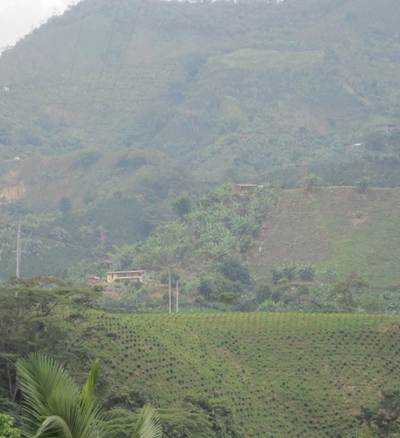
In an area where families have been growing coffee for generations there is in Caldas a strong coffee growing culture and the ability to use the local rich volcanic soil, excellent drainage and cool growing conditions to produce great Arabica coffee on virtually any plot of land. Here you will see people growing coffee on a hillside that is effectively their back yard. When you drive from Manizales to the neighboring million person city of Pereira you take the Coffee Highway, the Carrera de Café. As the photo taken from a roadside restaurant on the highway shows, there is coffee growing at 4000 just behind the restaurant up to 8000 feet on the distant mountain. I grew up in the American Corn Belt where you drive past miles and miles of corn, soybeans, corn and soybeans. Here it is all coffee but never on flat land! In short there is so much local competition that it is virtually impossible to jack up prices to stratospheric levels like with Gesha.
Unique Coffees and Advertising
When you do something like Google for “best coffee” you get websites that are well designed and made to rank at the top of a good search engine. They generally feature very good coffees but nothing that ranks in flavor, body notes higher than what is generally available for reasonable prices from the Colombian Cafetero. So, if you want a great Arabica coffee, buy coffee from Colombia. Just look for Juan Valez on the label.