The region of the entire world responsible for the highest concentrated production of the best Arabica coffee is the Colombian coffee growing axis known in Colombia as the Eje Cafetero. In addition to being a premier coffee growing region, the Eje Cafetero has an interesting history dating back to the early years of this region being a colony of Spain.
History of Colombia
Colombia was a colony in Spain’s new world empire with the Caribbean costal city of Santa Maria being founded in 1525. In the earliest colonial days, this region was the New Kingdom of Granada and produced gold using slave labor for its Spanish masters. During the precolonial days indigenous peoples included the Quimbaya, Muisca, Tayrona, and Muisca. These peoples had integrated agricultural system, made pottery and worked gold. The vast majority of the original population died off within years of the arrival Europeans due to infections such as tuberculosis and small pox although between four and five percent of today’s Colombian population is comprised of people with indigenous roots. Colombia broke away from Spain in the early 19th century with the battle of Boyacá being the crucial battle that led to the independence of what today are Venezuela, Colombia, Ecuador and Peru. Agricultural products for export included tobacco and cocoa in the earlies days and coffee in the late 19th century. The “violencia” in the middle of the 20th century led to a national power sharing agreement that inadvertently led to the rise of rebel groups that eventual turned to drug trafficking, primary of cocaine. Through all of this Colombia saw the steady rise of coffee production in the area just west of the western most ridgeline of the Andes. This area became the Cafetero Colombiano.
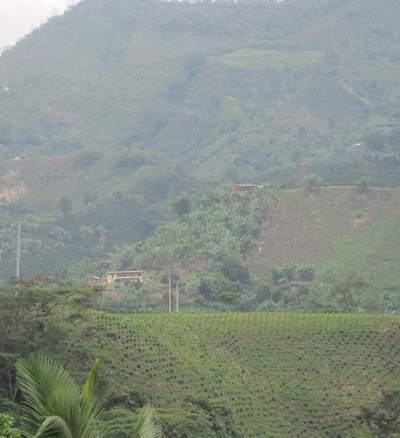
Coffee Fields Along the Coffee Highway in the Eje Cafetero
Coffee Growing in the Colombian Cafetero
Although the region of Caldas, Quindío and Risaralda was explored around 1537 it remained largely empty of people until the middle of the 19th century when a group of families moved to the mountain top area that is now Manizales in the department of Caldas. These folks took up coffee farming, taking advantage of the rich volcanic soil and excellent drainage which is excellent for producing great coffee. This area is virtually all mountains so there were never any large farms but rather small family holdings that have been farmed from the 19th century to the present. Today the three departments of Caldas, Risaralda, and Quindío make up about fifteen percent of all coffee production in Colombia. Add to this the adjacent areas of Huila, Tolima, and Antioquia and the percentage gets closer to thirty percent. Coffee from this area commands a premium to other coffees produced in Colombia which in turn commands a premium to the NYMEX price for coffee typically quoted as the price of coffee.
Cafetero Coffee Culture
Such is the uniqueness of the coffee culture in the Eje Cafetero that it is a UNESCO historical site. A backbone of the coffee industry in this area is the National Coffee Growers Association and Cenicafe, its research arm. In the most rural areas of the Cafetero “paisa” architecture predominates featuring timber and mud construction, bright colors, and earthquake resistant buildings. As might be expected in a region where travel can be difficult farming families can be somewhat isolated, coming into population areas only occasionally to shop or sell their coffee.
Modern Manizales in the Cafetero Colombiano
Manizales, Colombia lies in the heart of Caldas in the traditional heart of the Eje Cafetero. It is the coffee processing center for the region which is big part of its economy. However, the city has diversified into metal reclamation, manufacturing of appliances, and metal working. It has a strong service sector and is a “university town” with seven main universities located within the city limits. Although this is a safe and very polite town to visit and live in the number of North American and Europeans living in and around Manizales is largely limited to those who have Colombian spouses and have “come home” to Manizales to retire in the “land of eternal spring” at 8,000 feet.