Colombian is the leading producer of high quality Arabica coffee. It is also the home to numerous narcotics traffickers often working out of some of the same regions where the best coffee is grown. For years honest and hard working coffee farmers have lived their lives and done their work unencumbered by narcotraffickers even though they may be working in the same regions. Now Colombia has a new right wing president, Abelardo de la Espriella, who has promised to build ten mega prisons and round up drug traffickers with the help of US president Trump and the US military. Colombians are increasingly concerned about violence as “el presidente” and his plans move forward.
Pablo Escobar’s War with the Colombian Government in the 1980s
The 1980s war on drugs in Colombia was violent and hugely disruptive to Colombian society and businesses including the coffee business. In the 1980s the Medellin Drug Cartel under Pablo Escobar was the most powerful organized crime network in Colombia with Escobar being one of the richest people in the world. Adding to the mix at the time were paramilitary groups, the Colombian government, and guerilla groups that had been at war for decades. When the government chose to declare war on Escobar the result was billions of dollar in infrastructure damage hundreds of deaths of judges, high ranking police and military and countless civilians. By time Escobar was assassinated in 1993 the damage to foreign investment and the Colombian economy was so severe that it took three decades to recover.
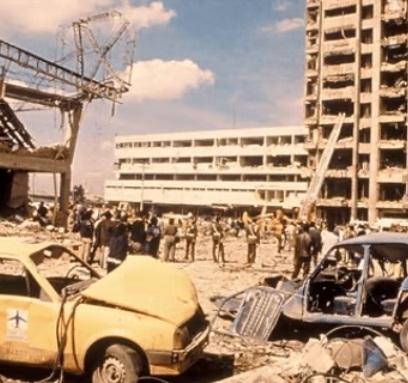
Bombing in Bogota Colombia During War with Escobar
How the 1980s Drug War Affected Colombian Coffee Production
Coffee and cocaine are best grown in similar locations and conditions. Thus, coffee farmers who only wanted to grow and sell their coffee often found themselves in the heart of military operations by government forces against cocaine traffickers and reprisals by cocaine traffickers and guerillas against military forces. Many families that had grown coffee in western Colombia for generations found the situation so dangerous that they simply left. It was not until long after Escobar’s death and a treaty between the Colombian government and FARC, the largest guerilla group that many coffee farmers returned to their farms and resumed operations. Not only were coffee farmers in remote locations in danger on their farms but travel and shipping coffee were dangerous due to roadblocks by the military, drug traffickers and guerrillas.
Is Colombia at Risk of Another Round of Violence?
Western Colombia is currently recovering from a historic 7.4 Richter scale earthquake that damaged buildings from Buenaventura from where coffee is exported up to Cali, Pereira, and Manizales in the Colombian coffee triangle, the Eje Cafetero. This occurred just after the new president was sworn in. Despite needing to address the damage to infrastructure and road in the region it appears that de la Espriella still wants to start a war with drug traffickers and may even have help from Donald Trump’s American military. For folks with a sufficiently long memory in Colombia this is raising concerns that drug traffickers backed by historic profits and wealth will fight back and plunge Colombia into the sort of chaos that reigned during the dark day of Pablo Escobar and the Medellin Drug Cartel. If this happens it could be disruptive to farming operations as well as transport and shipping of some of the finest Arabica coffee in the world. One might expect to see less Colombian Arabica coffee on the world market and at higher prices for years if not decades if the script of the coming war with cocaine traffickers follows the script of the Escobar years. We might also see higher prices due to the law of supply and demand for one only can guess for how long!