Coffee as we know it was first discovered in West Africa around 850 AD in what is today Ethiopia. Legend tells us that a goat herder noticed his goats becoming excited after eating berries from a bush that was a coffee plant. Although brewing of coffee occurred in Ethiopia the practice and commercial development of coffee did not occurring until Sufi monks brought coffee across the Red Sea to Yemen and cultivated it there. Because Yemen was part of the Ottoman Empire and the Arab world, this kind of coffee came to be known as Arabica coffee as cultivation spread into the East Indies and later to the Western Hemisphere. Robusta coffee does not have any similar story. Rather it came to be cultivated and a commercial success due to a plant disease that decimated East Indian Arabica coffee plantations.
The Rise of Coffee Leaf Rust
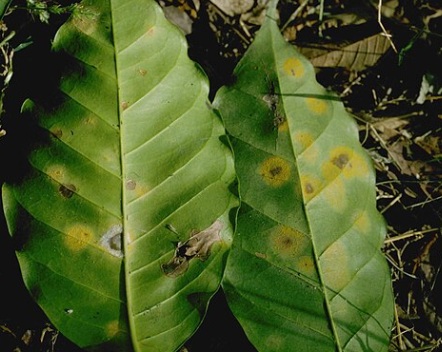
Wild coffee plants in Ethiopia grew in forested areas and were not cultivate as a monoculture with many plants grown side by side. When coffee first became a commercial success coffee came to be grown on coffee farms. This is the situation in which a plant disease can spread rapidly across all adjoining plant and destroy a crop. Coffee leaf rust is a plant parasite called Hemileia vastratrix which causes orangish-yellow sores resembling rust on coffee plants. Once it emerged in Ethiopia the disease spread across the Indian Ocean to Ceylon where it devastated coffee plantations and caused the country to switch to growing tea. As the disease spread to Indonesia and adjacent coffee growers folks started to look for coffee plants that did not catch this disease.
Development of Robusta Coffee Culture in Central and West Africa
While coffee was first discovered and developed in East Africa and across the Red Sea in Yemen the plant had already spread in the wild across Africa. The coffee that spread into the Congo River Basin, into Uganda, and as far as Angola was much more tolerant of heat than the Arabica coffee that grew in the Ethiopian highlands. As leaf rust decimated coffee harvests coffee farmers in these regions began commercial production. When plants were sent to Java, Indonesia to revive coffee growing in that region it was promoted as coffea robusta as it was resistant to leaf rust. By the turn of the 20th century Robusta coffee was established in Central Africa, the East Indies and South Asia. When leaf rust was first detected in southern Brazil in 1970 there was interest in growing Robusta in the Americas. But rather than moving to wholesale Robusta production organizations like Cenicafe in Colombia started developing cross strains that helped preserve the taste and aroma of Arabica coffees and adding disease resistance of Robusta. Today in Colombia much of the production is Castillo or Caturra which are leaf rust resistant. Old standard Arabica is only grown at the highest altitudes where cooler weather helps prevent leaf rust.
Robusta Coffee Production in Asia
In Vietnam and the East Indies where Robusta coffee is the dominant crop they are working toward the same goal as is Colombia, a better tasting coffee with better leaf rust resistance. But they are staring with Robusta and cross breading with Ethiopian or American strains.