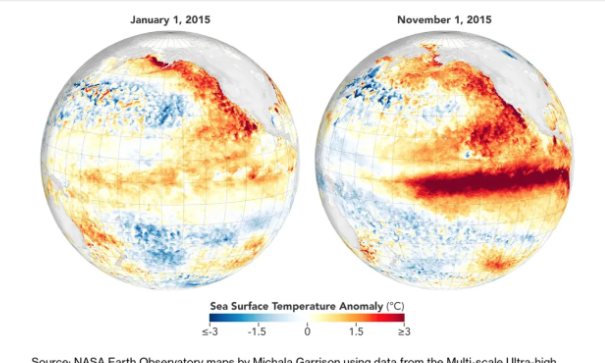
It has been a year since we wrote about drought in Brazil and resulting high coffee prices due to el Niño. Prices went up and then came down again as the El Niño La Niña cycle was completed. Now we are looking a much more powerful El Niño event, a Super El Niño. What will be its effect on coffee coming on top of problems with fuel and fertilizer caused by the Iran war.
What Is a Super El Niño?
El Niño is a weather pattern that starts in the Pacific Ocean and affects all of the world. It got its name from fisherman off of the coast of South American centuries ago who noticed that the water off of the coast was unusually warm around Christmas time. Thus they said the pattern was related to the “Niño de Navidad” or child of Christmas and the name stuck as the Pacific current and weather pattern returned every few years over the centuries. This recurrent event starts with the trade winds that normally push warm water from the coast of the Americas toward Asia weakening and even reversing direction. This leads to much warmer water temperatures off the coasts of South, Central, and North America. The strength of a given El Niño event is correlated with the temperature of Pacific surface water and this time around temperatures are higher than usual for an El Niño event. Thus it is expected to be a stronger or even “super” El Niño this time around. The “super” aspect will not stop with surface water temperatures but will carry on to effects on weather across the Americas, Asia, Africa and Europe.
How a Super El Niño Will Affect Coffee Growers Across the World
Because an El Niño arising in the Pacific Ocean can affect weather across the globe it can affect coffee production in major coffee growing countries like Vietnam and Indonesia. In both nations El Niño weather events tend to cause severe drought. Vietnam produces primarily Robusta coffee which usually provides a higher yield than Arabica. However, Robusta is more sensitive to prolonged dry conditions and especially tends to have fewer flowers during drought conditions and therefore potentially fewer coffee beans even on plants that survive dry conditions. During the last El Niño event, which was moderate in severity, coffee production in Vietnam fell by nearly twenty percent. Brazil, the world’s leading producer, saw a fall of just three percent likely due to its high production of Arabica coffees despite severe drought conditions. East Africa and particularly Ethiopia tends to experience drought during El Niño events which will likely add to the decline in production of coffee in this key coffee growing region. And Northern South America and Central America tend to get less rain during an El Niño event although the effects can vary by local quite a bit. For example in the mountainous Colombian coffee triangle rainfall was plentiful during the last El Niño cycle at the same time that Eastern Colombia experienced a drought and even saw forest fires.
Where Are We in the Coming El Niño Event?
The first step in an El Niño cycle is warming of water in the Pacific Ocean currents. The prediction of an El Niño more powerful than usual is based on temperature elevations greater than usual in the runup to an El Niño event. Meteorologists expect to see this phenomena advance leading to more powerful than normal El Niño by November 2026 to January 2027. How all of this works out will depend on the upcoming sequence of weather and current factors. The July national weather service climate prediction service says that the current El Niño event will keep getting stronger throughout 2026 and there is a ninety-seven percent probability that it will last through the spring of 2027.
What Will A Super El Niño Do to the Price of Coffee?
Coffee like other commodities obeys the law of supply and demand. People are still going to buy coffee during the coming El Niño cycle but production will be less. Thus we can expect the price to rise. If you look at futures on the COMEX you will see that futures for September of 2027 are selling at $3.10 a pound which is up from $2.50 just a couple of months ago. Thus coffee traders are paying attention to the El Niño forecasts and adjusting their futures bids accordingly. To the extent that predictions of a super El Niño pan out we can expect to see coffee prices go higher yet into next year.