Get the Lead Out with Coffee Grounds
If you don’t want lead in the water for your coffee, coffee grounds may be just the right thing. UPI reports that coffee grounds can use used to extract heavy metal ions, like lead from water. Italian scientists have used coffee-infused foam to remove lead from contaminated water.
Coffee-infused foam sounds like the brainchild of a chef or barista, but it’s actually the work of a team of materials scientists and chemical engineers. The foam doesn’t go on top of a drink, but it can make water safe to drink — that is if the water is contaminated with lead.
A team of researchers at the Italian Institute of Technology created a filter, a combination of spent coffee grounds and bioelastomeric foam.
In initial tests, the foam successfully removed 99 percent of lead and mercury ions from contaminated still water in 30 hours. In flowing water, the foam extracted 67 percent of the lead ions.
The scientists suggest using coffee to clean up water contaminated by lead and other heavy metal ions like mercury. Since billions of pounds of coffee grounds are put in landfills every year the spent product of making coffee could be put to a much better use. What else can spent coffee grounds be used for?
There is more you can do with coffee grounds than throw them out or use them to get the lead of out contaminated water. Last year we wrote about healthy coffee grounds. Researchers in Spain found that a high level of antioxidants remain in use coffee grounds.
Researchers from the University of Granada found that antioxidant levels in spent coffee grounds and coffee silver skin are especially high. The silver skin is one of the protective layers in between the outer coffee berry and the beans inside; it is typically removed prior to roasting.
Some consumers use spent coffee grains as a do-it-yourself exfoliant. Others deposit coffee grounds into their compost pile. But the vast majority of coffee byproducts make their way to the landfill.
That’s a shame, according to researcher and food science professor Jose Angel Rufian Henares. Henares’ research team found silver skins and used coffee grounds to be rich in fiber and phenols, and to have antimicrobial and antioxidant properties 500 times greater than vitamin C.
Researchers hope that their findings will inspire food producers and others to devise ways to recoup these healthy coffee grounds and make use of them in healthy products.
Coffee grounds have already found their way into skin care products.
Some medical research indicates that topical caffeine products reduce inflammation, reverse sun damage, provide antioxidant protection and minimize the appearance of cellulite. Although those scientific theories have not been definitively proven, they are causing some women to add caffeine skin products to their beauty regimen.
As Italian scientists find that you can use coffee grounds to remove lead from contaminated water beauticians are using coffee grounds to beatify their clients. There are certainly lots of useful things that you can do with coffee grounds rather than throw them out!
Do Millennials Drink Coffee?
Every generation has its nickname and its habits. Millennials are people who reached adulthood around the year 2000. Lindsey Pollak tells us that groups such as millennials share beliefs, attitudes and behaviors. Here is a little about millennials.
Demographers disagree, but the general number I use – and the one that Pew uses – is those who are between the ages of 18 to 34 in 2015.
Credit for the moniker “millennial” goes to Neil Howe and and the late William Strauss, who first used the term in the mid-90s and wrote Millennials Rising in 2000. It was outgrowth of work they had done for a book called Generations, which was among the first to explore the idea that groups share qualities such as beliefs, attitudes, values and behaviors because of the time period when they grew up.
Generation Y: Yes, “millennial” and “Gen Y” are the same thing.
Echo boomers: As children of Boomers, millennials make up the largest generation since their parents.
Digital natives: They are the first generation who don’t know life without the internet and personal tech devices.
Now, our question is do millennials drink coffee might they favor organic coffee or a least high quality coffee house coffee?
Coffee Culture and Millennials Engagement at Work
Forbes provides insight into the relationship between millennials and their coffee habits in their article about a culture around coffee.
Americans love coffee, with more than half of adults drink at least one cup per day. Millennials are avid coffee drinkers too, particularly with espresso-based drinks. According to one study, gourmet coffee beverage consumption among 25-39 year olds jumped from 19% to 41% between 2008 to 2016.
This change in coffee consumption started a shift in workplace coffee options. “Office coffee services have traditionally been the worst of the worst,” according to Jesse Kahn, national sales manager for Counter Culture Coffee, “and there’s been a lot of growth in companies recognizing the need for a better coffee experience.” Companies like Mars Drinks, for example, are working to provide higher quality coffee options.
It turns out that millennials do not necessarily drink more coffee than other generations of Americans, but they like good coffee and are willing to pay for it. In a world in which investments in the stock market and real estate have bottomed out right before our eyes, many millennials are “investing” in quality of life which includes better food and beverage experiences.
Businesses that want to maintain a high level of creativity and vitality in their work places are willing to pay for better designed work places and a better workplace experience and that, it turns out, includes a better cup of coffee at work.
Will Millennials Live Longer?
Since millennials like their coffee and there is evidence that drinking coffee helps you avoid a large number of serious diseases will millennials live longer? Will their years be more disease free? To refresh your memory on this issue take a look again at our article about the health benefits of coffee.
Want to Retire in Coffee Country?
If you really like organic coffee you may be someone who would like to grow your own during retirement. Interestingly U.S. News just published an article about 3 places to retire in coffee country. We were especially interested because one of the locations is where you can grow, pick and process your own coffee from Colombia.
If you like the idea of growing, sun-drying, roasting and brewing your own coffee – from berry to cup – you’ll be interested to know that prime coffee land can be found in some of the world’s most beautiful locations. What’s more, coffee grows best at an elevation of around 4,000 to 7,000 feet. This elevation also means great weather year-round.
If you’ve got a spirit of adventure and aren’t afraid of a little ground work, you could be harvesting your own coffee as part of your overseas retirement plan. Here are three top retirement destinations that are also ideal places for cultivating coffee plants.
These are the three locations that U.S. News suggests.
Coatepec, Mexico
50,000 person town close to the university town and capital of Veracruz State, Xalapa.
4,000 feet elevation where you can grow your own coffee
Valcabamba, Ecuador
5,000 feet elevation and the highest concentration of people over age 100
You can grow coffee here year round
Manizales, Colombia
This is our favorite, situated at 7,000 feet plus or minus about 700
Manizales is in the heart of the Eje Cafetero, the Colombian coffee growing axis where the best Arabica coffee in the world comes from
Manizales and environs have a million people but you don’t need to go very far from the center of the city to find farm land suitable for coffee growing. Nearby smaller towns like Chinchina and Santa Rosa de Cabal are local commercial centers and centers for coffee processing.
Manizales nestles under the heights of the 15,000 foot volcano Nevada Ruiz seen in this photo from the Caretera Hotel in Manizales.
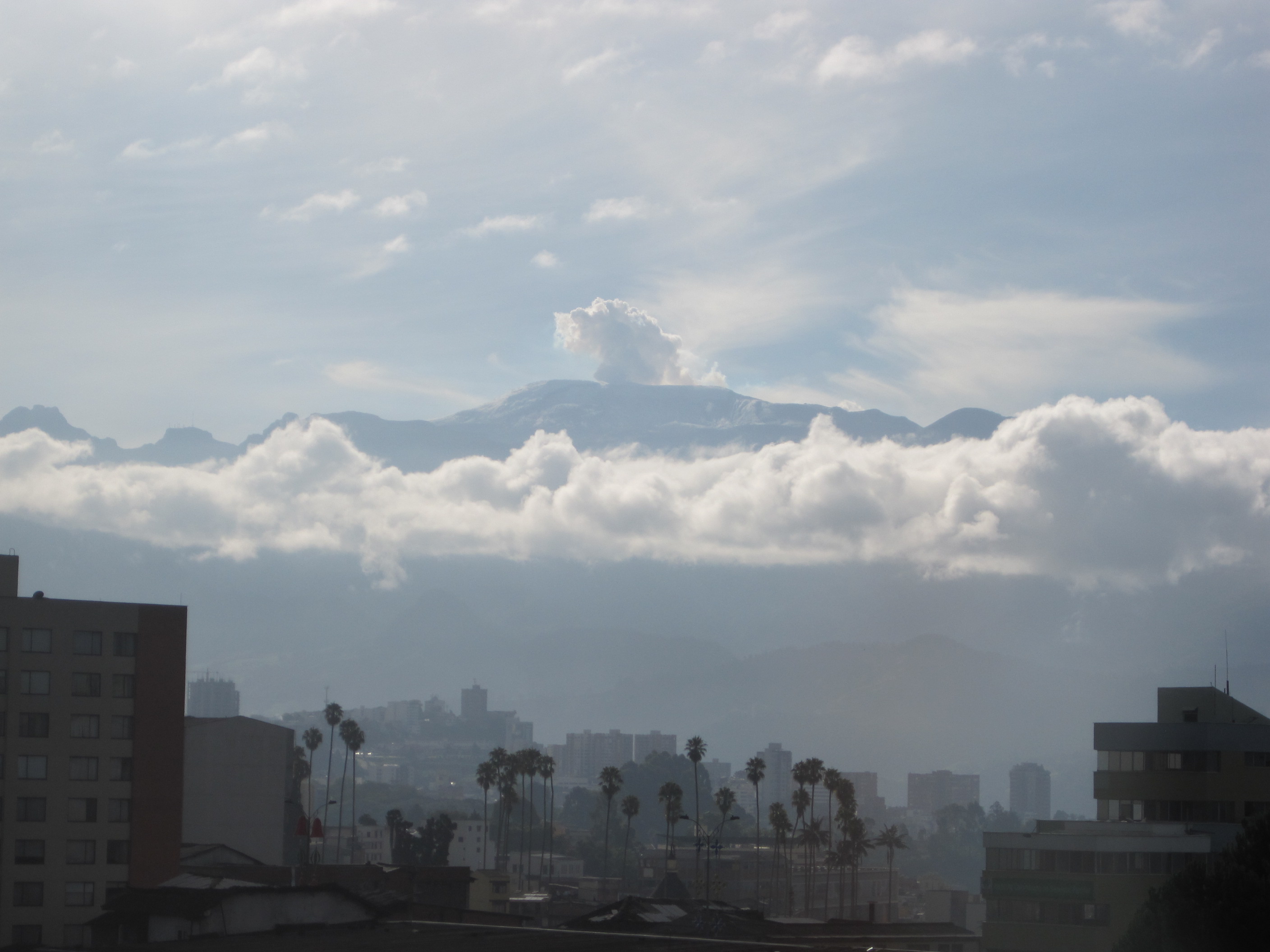
Nevada Ruiz
This is a town where you can go to a modern mall (Los Fundadores) and sip coffee at one of many coffee shops

Manizales: Juan Valdez Coffee Shop
or shop on palm lined streets with a panorama of mountain peaks.

Manizales, Colombia View
Manizales was founded around 1850 by coffee growers who came by ox cart specifically for the ideal soil conditions and climate. It grew from a small settlement to nearly a million persons including the “suburbs” by extension up and down the hills ranging out from the mountain top center of town.

Manizales, Colombia Keeps Growing
Mountainside Coffee Farming
If you move to Colombia and buy a piece of land for growing coffee you will be one with your neighbors. It is common to see coffee growing in back yards, especially on hillsides in the Eje Cafetero. The Carturro variety is commonly seen growing at lower elevations (3,000 to 5,000 feet) and standard Arabica is grown closer to 7,000 feet. You farm could well end up being on the mountainside where your home is on the only flat ground and you use the slope for growing coffee.
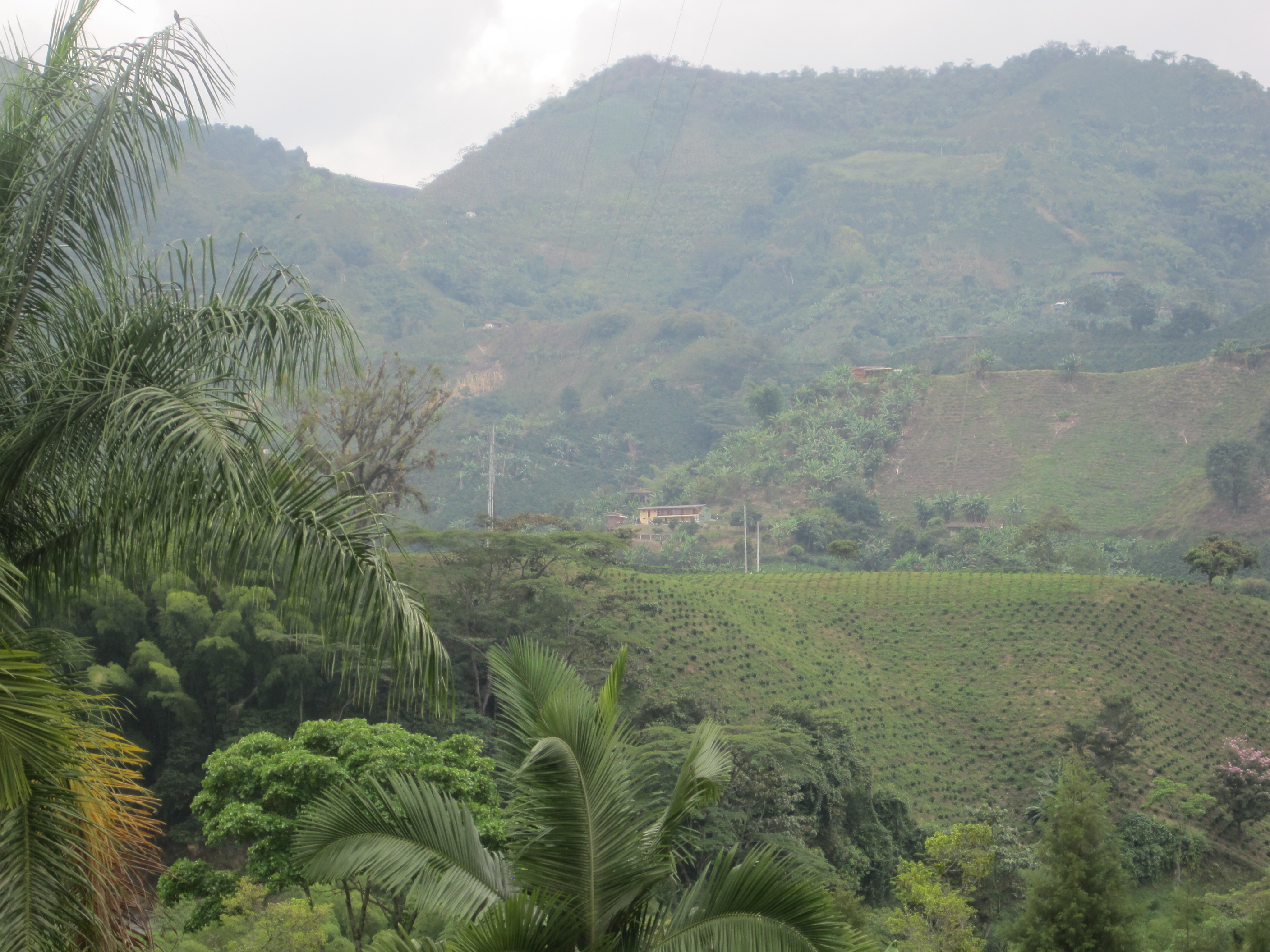
Coffee in Colombia
Coffee growing from the lowlands to the mountain peaks is common around Manizales.
What Is a Dangerous Amount of Coffee?
We have written a lot about the health effects of coffee. In general more coffee is better in reducing your risk of type II diabetes, Alzheimer’s, Parkinson’s, depression and various types of cancer. But what is a dangerous amount of coffee if you get carried away? Mashable reports that the world’s strongest coffee which is served in Adelaide, Australia at the Viscous Café is pretty strong.
A cafe is serving up the coffee to rival all others and it looks almost fatal.
The suitably-named Ass Kicker is being served at Viscous Cafe in Adelaide, Australia and it contains the caffeine equivalent of 80 standard cups-o-joe.
Legend has it, the first incarnation of the beverage was made for an emergency department nurse who needed to stay awake. The drink was consumed over a period of two days and kept the nurse up for three days in total.
A regular eight ounce cup of coffee contains about 95 milligrams of caffeine. Heavy coffee drinkers (five cups a day) consume just less than 500 milligrams. A large coffee served at the Australian café contains five grams (5,000 milligrams) of caffeine. Is that a dangerous amount of coffee? The café has a sign warning folks with high blood pressure, heart disease.
Lethal Dose of Caffeine
According to experts the lethal dose of caffeine is around 10 grams for an adult. That would be two cup of the Australian coffee chugged down back to back. According to Popular Science discusses how much caffeine it would take to kill you. It turns out that document death from caffeine overdose is rare.
So if a true caffeine overdose is so rare, why has caffeine-perhaps the most widely used drug in North America-been blamed for contributing to a handful of deaths over the years? Perhaps because it almost always works in concert with other far more nefarious factors such as alcohol or heart conditions.
Individuals with heart diseases that predispose to fatal rhythm disturbances are more likely to die from a large amount of coffee than someone with a totally healthy heart. Too much caffeine raises blood pressure. If you already have high blood pressure and drink a large amount of coffee, or one of the Australian varieties, you may see a dangerous spike in your pressure. Systolic pressure over 180 or diastolic over 120 constitutes a hypertensive crisis. This requires immediate attention and treatment to prevent stroke, heart attack, loss of kidney function and more. In short what is a dangerous amount of coffee is different if you are totally young and healthy versus if you have heart problems, high blood pressure or other conditions that may be made worse by too much caffeine.
Common Sense
If you need to stay awake on the road and want to use coffee for that purpose stick with a normal cup of strong coffee and stop every couple of hours to refill. This way you will not be taking a chance of having an overdose.
Why French Press Coffee?
There are various ways to make coffee and reasons why you might prefer one over the other. In this article we consider why make French press coffee. The Life Hack web site offers six reasons why they say French press makes the best coffee.
Many people believe French press makes the best coffee. These are some reasons why.
Paper filters take out flavor and oils. When eating good foods, the flavor usually exists in the fats and oils. Paper filters in drip machines absorb much of the oil in your coffee grounds. French press doesn’t soak up flavor and adds tiny bits of coffee grounds in the coffee that percolates flavor.
French press allows for steeping. When you get a good cup of tea, you use bulk tea that steeps for several minutes depending on the type of tea. The end result is a mouth-watering cup of tea. The same is true for coffee through a French press. Because the grounds steep instead of filter, the coffee tastes better.
When you use a French press the coffee steeps just like tea. Because no filter is used you get the oils and particulate matter that contains so much of the aroma and flavor of the coffee. And the temperature of the coffee remains the same throughout the process until you pour into your coffee cup.
Just What Is a French Press?
A French press is a coffee pot, typically glass, with a fine wire mesh plunger. Coffee grounds are added to the pot followed by hot water. The coffee is allowed to steep for a few minutes and then stirred briefly. Then the plunger is pushed down through the coffee. The bulk of the grounds are pushed to the bottom of the pot.
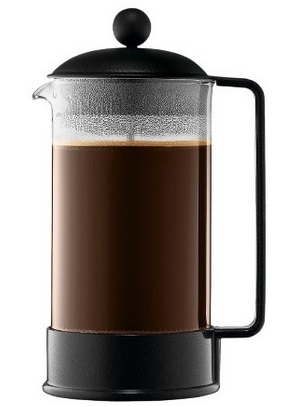
French Press Coffee Maker
Cold Brew Coffee with a French Press
First of all make cold brewed coffee as we described in our article of that name.
Our preference is to start with organic coffee, preferably one of the Colombian organic coffee brands. Grind the beans but coarse and not fine like you would with expresso. Ideally use bottled water and not chlorinated from the tap. If you do use tap water pour the water into a pitcher and allow to sit for several hours to let the chlorine evaporate from the tap water. Grind four and half ounces (1 ¾ cup) of coffee. Add three and a half cups of cold water to a two quart pitcher and then the coffee grounds. Cover, place in the refrigerator and forget for a dozen hours.
When you have done this the only issue is getting the coffee into your cup without the grounds. That is not hard for the first cup but difficult as the pitcher empties. A great use of a French press is to pour your cold brewed coffee into a French press and then use the wire mesh strainer to keep the bulk of the grounds out of your cup. At the same time when you use a French press you will not strain out the oil and tiny particles of coffee that contain so much of the flavor and aroma.
How Can Coffee Affect Your Body?
Coffee is the wake up beverage for millions of people. About one billion four hundred million cups a day are consumed on planet earth. And everyone knows that if you drink a lot of coffee it gives you a buzz, makes you feel nervous. But how else can coffee affect your body? How about better sex, improved athletic performance, longer life and freedom from several serious diseases? Let’s start with athletic performance sexual and otherwise.
Coffee and Extracurricular Activities
Interestingly scientific research shows that coffee can lead to sexual arousal in females. Studies of sixtyish men and women show that coffee drinking women have sex more frequently and coffee drinking men have higher potency. A common sense finding is that coffee gives you a physical and mental boost that can carry over into more energy when making love.
Coffee and the Workout
Does coffee enhance athletic performance?
We know that coffee wakes you up if you are sleepy. This is probably more important in in interactive sports like tennis, soccer, basketball, etc. where it is important to pay attention no matter how tired you are. But, how does coffee enhance athletic performance in sports like long distance running or weight lifting? Here is the Cliff Notes version.
- Via a series of chemical regulatory pathways in the human body the caffeine in coffee affects the regulation of glycogen, sugars and lipid metabolism and stimulates the release of adrenaline.
- Coffee can be effective to enhance performance when ingested as close as fifteen minutes before exercise or competition although an hour before is ideal to insure complete absorption and initiation of the regulatory pathways the help coffee enhance athletic performance.
- Coffee is effective in enhancing athletic performance in moderate amounts, three to six milligrams per kilogram of body weight and larger amounts do not appear to help.
- An eight ounce cup of brewed coffee contains from 100 to 200 milligrams of caffeine.
- A 154 pound runner weighs 70 kilograms.
- Since three milligrams per kilogram times seventy kilograms comes to just over 210 milligrams it turns out that one stiff cup of coffee taken within an hour of performance will likely enhance athletic performance.
- Two cups may be better but three will be a waste of time.
And Avoiding Diseases
The other collection of effects of coffee on your body have to do with reducing the incidence of diseases like Alzheimer’s and Parkinson’s as well as depression and suicide. A dramatic effect on a major disease is that more coffee leads to less diabetes, type II.
Researchers found the following. Women who drink at least four cups of coffee a day have less than half the incidence of Type II diabetes as women who do not drink coffee. The coffee drinkers all had elevated sex hormone-binding globulin levels while the non-coffee drinkers did not. The relationship was complete between the elevated enzyme level and a reduced incidence of Type II diabetes.
The American Diabetes Association says that nearly 24 million Americans have diabetes of which more than 9 in 10 have the Type II variety. That comes to roughly 22 million people with Type 2 diabetes. The fact that more organic coffee can lead to less diabetes could be a significant issue in US public health.
Add to these the reduction in prostate, endometrial and colon cancer, less risk of dying in the coming few years and more and you have more reasons how coffee can affect your body and why drinking a cup or two or three of java each day is a good idea.
Where Will We Grow Coffee when the Earth Heats Up?
A recent study by The Climate Institute on behalf of Fair Trade Australia predicts that coffee production in current areas where it is grown will fall significantly in the coming years as temperatures and high altitude rainfall increase. Here is a bit about the climate change risks to coffee.
The coming decades are likely to see dramatic shifts in where and how much coffee is produced worldwide. Regional studies suggest rising temperatures could render much Mexican coffee unviable by the 2020s, and most of Nicaragua will lose majority of its coffee zone by 2050, and Tanzanian Arabica yields are projected to reach critically low levels by 2060.
According to a 2015 global study, hotter weather and changes in rainfall patterns are projected to cut the area suitable for coffee in half by 2050 across different emissions scenarios. The details differ markedly with locality, but the impacts are likely to be heaviest at low latitudes and low altitudes.
Elsewhere, the predicted effects are still negative albeit less pronounced. Brazil and Vietnam-two of the biggest producers-appear set to experience substantial losses. Conversely, the climate of 2050 seems to favor some areas, particularly in the highlands of East Africa-as well as in Indonesia, Papua New Guinea, and the Andes. Before the century is out, however, conditions are set to become inhospitable for Arabica coffee in the wild in East Africa-its center of origin.
According to these folks Colombia as well as other Andean producers may continue to produce in volume. We have written before about coffee leaf rust and how the disease has pushed production of Arabica coffee up the mountains to higher and higher altitudes. If climate change ramps up temperatures higher and higher just how far north can they grow coffee? It turns out that during the epoch known as the Eocene there were palm trees and crocodiles in Greenland!
The Eocene Extreme
An NOAA (National Oceanic and Atmospheric Administration) website, Climate.gov says that the hottest the earth has been was the Paleocene-Eocene Thermal Maximum about 56 million years ago. This is the period after the extinction of dinosaurs with mammals on the rise. At that time there were no polar ice caps and crocodiles and palm trees were prevalent around the Arctic Circle.
The planet has sometimes been much warmer than it is now. One of the warmest times was during the geologic period known as the Neoproterozoic, between 600 and 800 million years ago. Another “warm age” is a period geologists call the Paleocene-Eocene Thermal Maximum, which occurred about 56 million years ago.
With that thought in mind is it impossible to assume that given tens or hundreds of years that coffee growers would not move gradually north and south seeking mountainous regions of heavy rainfall and cloud cover in order to grow high quality coffee? Given that changes occur gradually one might assume that coffee production would gradually migrate to more hospitable regions.
Is Your Coffee Habit Inherited?
You think that you drink coffee because you like the taste and aroma or because it wakes you up in the morning and keeps you going all day. Is that true? Maybe, as an article in the Los Angeles Times suggests, your coffee habit may be written in your DNA.
Scientists have been studying the genetics behind coffee cravings since the 1960s. In 1962, they found that coffee-drinking habits appeared to be hereditary. More recently, large-scale studies have found an association between the amount of coffee people consume and a small handful of genes.
The authors report that among more than 1,200 people living in Italy, those with the genetic variant PDSS2 tend to drink one fewer cups of coffee per day than those without the variation.
Further analysis revealed that expression of the PDSS2 gene appears to inhibit the body’s ability to break down caffeine. If that’s the case, people with this variant would require less coffee to get a strong caffeine jolt because the caffeine would linger in their system for a longer time.
So it turns out that some folks need less coffee to keep going because they do not metabolize it as fast as the rest of us. If you are one of the folks who drink six cups a day it may just be that your system is breaking down and excreting your coffee faster that other folks. If that is your case blame your parents who passed on that trait.
How Does This Affect Coffee’s Health Benefits?
We know that coffee drinkers have a reduced likelihood of getting Type II diabetes as well as multiple sclerosis, melanoma and liver cancer. And in general the benefit increases the more coffee that you drink. What we do not know is if those folks who require less coffee because they break it down faster still get the benefits of coffee consumption, namely a reduced chance of dying in the next few years, less Alzheimer’s and Parkinson’s diseases and the rest. A more recent report shows that drinking coffee after a heart attack is helpful.
British researchers at York University tracked over 3,700 heart-attack survivors and their coffee-drinking habits.
They found patients who regularly drank at least one cup of coffee a day had a 20 percent reduced risk of death from heart damage compared with those who never drank coffee. And heavy drinkers, those who consumed two or more cups a day were nearly half as likely to die prematurely. Why these findings are important is because once you have a heart attack, you’re at high risk for another heart attack or for developing heart failure.
People who have had one heart attach have a higher risk of getting another than people who have not had their first attack. Researcher believe that the flavinoids in coffee help reduce the buildup of arteriosclerotic fatty deposits in artery walls, improve blood vessel function and reduce blood pressure. So, whether your coffee habit is inherited or not, coffee is good for you for many reasons.
Cuban Style Coffee
Now that relations are improving with the island of Cuba it may be time to revisit Cuban style coffee. It turns out that Cuban coffee does not necessarily refer to coffee from Cuba but to the method of preparation.
Cuban coffee is strong espresso with a foamy layer of sugar laced with espresso across the top. Make the espresso as you normally would. Then put a forth of a cup of brown sugar in a glass mixing bowl and add a tablespoonful of hot espresso. Mix using a whisk until the mixture is foamy. Pour this over each cup of steaming hot espresso and enjoy your Cuban coffee, aka Café Cubano.
Our preference is organic Colombian coffee but if you can get your hand on beans from Cuba by all means try them out. Two old Cuban brands are Pilon and Bustelo. Both are dark roasted which can be important if you want to mimic the experience of original Cuban coffee.
How did café Cubano come to be? The Huffington Post explains in their article about making real Cuban style coffee.
If you order Cuban coffee out, it will often be made with an espresso machine, but you can easily make a good cup of it at home with a moka pot. Actually, that’s how a lot of Cubans do it themselves. The use of sugar to make the crema is said to have developed as a way to mimic the “heady crema of a cafe-bought espresso” without having to pay the price asked for at the cafes.
The sugar-laden espresso culture could also be a result of the quality of coffee rationed out to Cubans over the years. With the production of Cuban coffee on the decline since the 1960s, less was available on the market. So the government began to ration out 4 ounces of coffee a month to its citizens. And that small amount that was handed out was cut with ground chicharo bean, known as cafe con chicharo. It makes an earthy, bitter brew, which wholly welcomes sugar.
Think of chicory coffee used when coffee was rationed during the war years.
If you have visited New Orleans there is a good chance that you have tasted chicory coffee. What is chicory coffee? Chicory coffee contains the root of the chicory plant. Chicory grows wild in Europe and has adapted to North America and Australia. Roasted and ground chicory has a flavor similar to coffee so when coffee has been scarce chicory has been used as a substitute either entirely or in part.
The difference, of course, is that Chicory coffee is a blend of two ingredients while Cuban style coffee uses sugar to pep up the taste and imitate the crema on top of a good cup of espresso. We doubt, however, that Cuban style coffee will make it as far as espresso in space.
Last month, the Dragon spacecraft, built and operated by SpaceX, delivered the first-ever space espresso machine, built by Italian coffee company Lavazza and Italian aerospace firm Argotec, to the space station, along with special, zero-gravity cups. Prior to the coffee machine’s long-awaited arrival, the only option aboard the orbiting laboratory was powdered instant coffee. The cups, co-designed by International Space Station researcher Mark Weislogel and astronaut Don Pettit, are peculiarly shaped so that a sharp corner makes the liquid inside stream toward a person’s mouth when they drink from it.
So, earth-bound coffee lovers, try making Cuban style coffee at home and enjoy the sugary crema.
How about Coffee Lemonade?
I still remember my first espresso years ago. It was at the Colombia restaurant on St. Armand’s Circle on Siesta Key (Sarasota, Florida). It arrived with a thin slice of lemon. Now, it turns out, baristas have taken the lemon with your coffee thing a big step farther. How about coffee lemonade? Eater reports that you need to try coffee lemonade.
If life hands you lemons – and iced coffee – well, then you’re primed to join the throngs obsessing right now over iced coffee lemonade. The acidic, sunshiney flavor combo rose from a few quiet sleeper cells to a flash food blog phenom, all when bowl-cuisine expert Lukas Volger Instagrammed an unusual beverage this past June. It was an Almond Palmer iced coffee lemonade served by Stand Coffee at Brooklyn, New York’s weekly Smorgasburg outdoor food market, and suddenly everyone wanted a sip.
The beverage, says Stand co-owner Bryan Hasho, is “nothing fancy.” Built of lemon and vanilla simple syrup, cold brew coffee, and a splash of almond milk over ice, the drink has been on offer beyond Smorgasburg, at Stand’s mobile coffee setup, and at their Manhattan coffee bar inside the Meatpacking District’s Samsung Experience building since Stand’s debut in March 2015.
As new and exciting as this sounds there is a longer history of coffee and lemons. Although both coffee and lemons were expensive and hard to get the old Soviet Union coffee with lemon, plus a little cognac or other liquor was common when the ingredients were available. Yahoo Answers provides a note from a native born Russian.
This is recipe from book “People’s commissariat of USSR to Housewife”, 1939
(word-by-word translation)
Black coffee with lemon, cognac or liquors
Boil black coffee in regular way, but increase quantity of grinded coffee up to 1,5 tea spoons per cup. Serve prepared coffee into cups. Separately serve cut lemon pieces, cognac or liquor.
So add a little lemon to your espresso and say, vashe zdorovie which means, to your health.
But Not Too Much Lemon
Eater quotes New York City barista, Sam Lewonthin.
“Coffee is chock-full of flavor compounds called Maillard saccharides, which are created when sugars and proteins are heated together,” as during roasting, Lewontin says. “As a category, Maillard saccharides are complex and nutty, and just about everybody loves them -and the best coffees have plenty of intrinsic fruitiness complementing their nuttier and more caramel-like qualities. These fruit flavors are often quite delicate, though; when we make drinks in which coffee is only one of several ingredients, they’re easily overwhelmed. In the right quantity, lemon juice can support those delicious fruit flavors, and balance out all of the sweet, nutty goodness of those Maillard saccharides, leading to a drink that’s refreshing and complex, and reflects the very best of what great coffee can be,” states the barista.
So add a little lemon to your coffee, make coffee lemonade and don’t block out the natural flavors of your healthy organic coffee.