Organic Decaf Coffee K Cups
If you like organic coffee but too much coffee gives you the jitters, you may want organic decaf coffee.
To meet FDA labeling requirements 97% of the caffeine has to be removed. A six ounce cup of Robusta coffee commonly has as much as 200 milligrams of caffeine. A cup of shade grown organic coffee from Arabica beans usually has between 70 and 130 milligrams of caffeine. To be labeled as decaf these coffees need to be reduced to six and about three milligrams per six ounce cup. The moral is that if you want to avoid caffeine you should start by looking for decaf Arabica coffee. Unfortunately most commercial brands of decaf are made from Robusta beans. Remember that decaf does not mean caffeine free.
If you are also tired of wasting coffee by making a batch and throwing out half then you may want to look a single serve coffee approach.
The USA is steadily consuming less coffee, not because anyone is cutting back but because of the single serve revolution. Bloomberg Business reports on how single-serving pods have decreased coffee consumption.
Single-serve brewing machines popularized by Keurig Green Mountain Inc. are now used by more than one in four Americans and are altering the way coffee is consumed. Almost every brand, from Folgers to Dunkin’ Donuts, is sold in disposable 2-inch-by-2-inch plastic pods that yield just one serving. They’re more efficient than drip-brewing pots capable of making 10 cups, some of which isn’t consumed and gets dumped.
While Americans still drink more coffee than any beverage except water, expanded use of single-serve machines has slowed demand growth for a $52 billion market in the U.S., the world’s biggest consumer. That’s hurt sales at a time when ample inventories of the commodity have sent prices tumbling.
One observer says that coffee farmers have lost their most lucrative consumer, the kitchen sink where unused coffee poured.
And if you like single serve, organic and decaf then you need organic decaf coffee K cups. At Keurig online you can order Newman’s Own Organics decaf coffee in a k cup. Bed Bath and Beyond offers Gorilla Decaf from the Organic Coffee Company. And Green Mountain offers Colombian Fair Trade decaf in k cups as well.
Organic Decaf Coffee K Cups
The argument for decaf coffee is that it does not make you nervous. However, if you drink high quality Arabica coffee it has less caffeine than cheaper Robusta. And if you limit your coffee intake the issue of nervousness goes away. The advantages of k cups are the ease of making a single cup of coffee and not wasting excess coffee along the way. The drawback to getting your organic coffee, decaf or not, via a k cup is that you are contributing a lot of plastic containers to the landfills of the world which may not make sense if you are going organic to protect the planet.
Keurig sells a lot of coffee and a lot of folks like the singe serving approach because it is easy and does not waste coffee. The trouble is that there is a lot of other waste with this product that goes against protecting the environment.
The best solution is to look for biodegradable containers for your k cups and then you are home free.
Gift Ideas for Coffee Lovers
The holiday season is almost upon us and it is time, again, to find gifts for those hard-to-shop-for people in your life. If any or all of those folks enjoy their cup of java here are a few gift ideas for coffee lovers.
Gift Cards
First of all for the coffee lover who picks up a cup on the way to work in the morning how about gift certificates? As an example you can buy a Starbucks gift card along with your coffee or purchase one online. On their gift card page you can also recharge cards as well. You can also get gift cards for Caribou, The Coffee Bean and Tea Leaf, Tully’s, etc. This a practical gift for the otherwise hard to shop for coffee lover.
Home Roasting
On the other end of the spectrum from those who only buy coffee house coffee are those who buy green coffee beans and roast their own. Our roast your own coffee article has a few suggestions.
If you are a true coffee aficionado you may choose to roast your own coffee. What does this entail? Can you get good at it? What do you have to buy? We looked on the internet for a list of coffee roasters and found a few suggestions and brands. Here is some info if you want to start to roast your own green coffee beans.
Here you either need to know just what the person wants or buy a gift card for a store that sells a variety of coffee roasting devices.
Whole Bean, Grind Your Own
Your hard to find a gift for coffee lover may not want to roast their own coffee but may like the fresher taste of high quality whole bean organic coffee ground just before brewing. In this case you need to find a nice coffee grinder or a shop that sells a variety of them and offers gift cards.
Organic whole bean coffee may be the best way to preserve organic coffee antioxidants when buying organic coffee. Antioxidants are chemicals that inhibit damage done to the human body by chemicals called free radicals. The health benefits of antioxidants are many and, in fact, organic coffee contains antioxidants capable of reducing the chances of getting diabetes, colon cancer, and prostate cancer. An often overlooked problem with antioxidants is that these chemicals themselves breakdown with time and improper storage conditions. To preserve antioxidants in foods such as organic coffee they should be kept at less than 68 degree Fahrenheit and out of the light. Ideal containers are dark and products such as organic coffee should ideally be kept in a closed cupboard.
And make sure to include a high quality storage container with your gift of a coffee grinder.
Better Coffee, Delivered to Your Door
The best Arabica coffee comes from the Eje Cafetero in Colombia. Your coffee loving hard to buy a present for friend will be very impressed if you contact us at Buy Organic Coffee and set up UPS or FEDEX monthly delivery of either green or freshly roasted coffee from the mountains of Colombia or even Panama. Check out our coffee price list page or contact us today.
What Is Organic Ganoderma Coffee?
A mushroom that only grows in remote mountain regions of China is nick named the treasure of life or spiritual potency (after its Chinese name, Lingzhi). Now this renowned product is certified organic. What is organic ganoderma coffee but a combination of organic coffee and organic ganoderma? What are the benefits of ganoderma coffee? Very Well discusses the issue.
Ganoderma coffee is a powdered drink mix that typically contains instant coffee and the powdered extract of Ganoderma lucidum (a medicinal mushroom often referred to as “reishi” or “Lingzhi”). Other ingredients such as sugar, non-dairy creamer, and other herbs may be included. It’s a product that some proponents say offers a range of health benefits and is sometimes used by people who would like to reduce their coffee intake but still boost their energy level.
Despite the marketing claims for the benefits of Ganoderma coffee, however, there is no scientific support for the product’s health effects.
The fact of the matter is that no one has done any research to see if ganoderma coffee has any health benefits above and beyond the health benefits of drinking coffee. But some work has been done on ganoderma itself.
For instance, a 2003 study of 34 advanced-stage cancer patients found that Ganoderma may help strengthen the immune system in people with cancer. Published in Immunological Investigations, the study found that 12 weeks of treatment with Ganoderma supplements enhanced the immune response in most participants.
What’s more, findings from animal-based research and test-tube studies suggest that Ganoderma may help knock out breast cancer cells, reduce airway inflammation associated with allergies, and lower cholesterol levels.
Coffee is good for you and organic coffee is better but too much coffee gives you the jitters and keeps you awake at night. What are the side effects of ganoderma coffee?
Side Effects of Ganoderma
Ganoderma side effects include dry nose and throat, nausea interactions with medications like anticoagulants and chemotherapy meds. There are also case reports of people who came down with hepatitis after taking ganoderma products. At least one reported case was a fatality.
Is This an Herbal Supplement or an Unregulated Drug?
For more than a century the United States has had laws requiring that medications do not cause any harm. For forty years the law has required that medications do what they claim to do. These laws, unfortunately, do not apply to dietary supplements. Thus products like ganoderma are commonly marketed in such a way as to suggest that they have numerous benefits to your health. However, if you read the fine print they never really say that. If they make clear claims about the effectiveness of their products the Food and Drug Administration will require them to provide proof or take their products off the market. Thus the way these products are marketed is to provide “testimonials” about how someone felt better or suggests this product to friends. This level of “proof” is not scientific and not based on research. So, go ahead and try some organic ganoderma coffee but be aware that while there is a ton of proof that coffee is good for your health you may be wasting your money by adding the mushroom from China.
Organic Coffee with Chicory
Organic coffee is good for you and typically an organic coffee is high quality Arabica as well. Chicory is a time honored coffee substitute that you can obtain in organic form. Why would you want organic coffee with chicory? First let’s look at the benefits of chicory. The Organic Facts website discusses the benefits of chicory.
Chicory is a woody, herbaceous plant that has a wealth of health benefits, including the ability to ease digestive problems, prevent heartburn, reduce arthritis pains, detoxify the liver and gallbladder, prevent bacterial infections, boost the immune system, and reduce the chance of heart disease. It is also a natural sedative, and can protect against kidney stones, and benefit attempts to lose weight. All in all, this small plant is a powerful addition to any diet.
Chicory increases bile flow from the liver which is how it improves digestion. This increases the breakdown of fats that we eat. In addition chicory contains inulin which helps keep the bacterial flora in the intestine healthy. And chicory like many herbs is high in antioxidants which puts it right in the same ballpark as coffee as an antioxidant source.
Antioxidants help prevent the damage caused by excessive oxidation and to a degree inhibit the aging process. When an oxidative reaction brought on by disease gets going it produces free radicals that start chain reactions which in turn cause cell and tissue damage. The human body has or uses antioxidants to control this situation. Natural means of controlling oxidation include vitamins C and E as well as glutathione. It is low levels of antioxidants that can lead to a condition referred to as oxidative stress and resultant damage to cells in the body. Organic coffee antioxidants are in the same class of molecules that help reduce oxidation.
We have previously written the plant has also been used as a coffee substitute.
Chicory coffee is common in Southeast Asia, South Africa and the Southern USA, especially New Orleans. Elsewhere Chicory has been used when coffee is not available such as during the Second World War in Europe and everywhere outside of coffee producing countries in the Great Depression. Strong blond Belgian style ales often contain chicory to augment the hops.
Making Organic Coffee with Chicory
You can certainly buy coffee, chicory or a mixture of both. But if you want to do it right, how do you make chicory coffee?
Starting with fresh chicory root, preferably from your own garden, pick and clean.
Cut into slices and dry in the sun or in the oven on low temperature.
Roast the chicory in the oven at 350 degrees Fahrenheit for at least half an hour or longer for a “darker” roast.
Grind the roasted chicory chips, twice as they do not grind as well as coffee.
Grind your whole bean organic roasted coffee.
Make the first batch with half coffee and half chicory.
Then adjust to taste in later batches.
Chicory has a chocolate and malt-like aroma and flavor. It is slightly more acidic than coffee. Drink your organic coffee with chicory and think of New Orleans.
Do Coffee Stains Come Out?
You are in a hurry as you leave the coffee shop on the way to work and some of your coffee misses your mouth and ends up on your blouse, shirt, skirt or pants. Do coffee stains come out? That is the primary question provided that the coffee was not too hot in which case your concern would be second and third degree burns. But let’s get back to the stains.
Removing Coffee Stains
The first thing to do if you spill coffee on a garment is to rinse it in cold water rubbing gently. Repeat two or three times as needed. This advice is from the Cleanipedia web site. Here is the rest of what they say about how to remove coffee stains.
Coffee can be one of the most troublesome stains to get out of clothing and carpets, but there are several strategies you can use to treat the stain. Here’s a step-by-step approach to getting rid of a coffee stain. Depending on the age and size of your stain, more vigorous effort may be required, so simply follow each step and repeat until it’s gone.
If you cannot immediate remove the garment, blot the stain with a paper towel or tissue to remove excess liquid.
Then rinse as able with cold water for as long as 5 minutes running water from the back of the stain to the front. Rub gentle every minute or so.
Gently rub a small quantity of laundry detergent into the stain and massage. Rinse after five minutes.
A backup approach if the stain remains is to mix white vinegar with detergent, test on a corner of the fabric to make sure that it does not discolor and rub into the stain. Scrub with a brush and rinse.
Finally if nothing has worked so far try a stain stick like Persil but again test on a corner of the fabric first.
The last choice is to take the garment to a dry cleaner.
At all costs to not put the garment with any residual stain in a dryer or in the sun because heat will set the stain, permanently.
Don’t Spill in the First Place
Coffee stains in the work place are enough of an issue that Bloomberg published a review of the best spill-proof travel mug. If you want to avoid coffee stains in the first place consider this approach.
Stainless steel travel mugs can be the perfect workplace complement: The simple vessels promise to keep their cargo both warm and away from clothes and keyboards. We subjected five popular models to a battery of tests designed to simulate years of real-world use and abuse by workers.
We tested four of the bestselling and highest-rated travel mugs on Amazon-the Zojirushi SM-YAE48 Travel Mug, the Thermos Vacuum Insulated Stainless Steel Double Wall Direct Drink Bottle, the Contigo Autoseal West Loop Stainless Travel Mug with Easy-Clean Lid, and the Oxo Stainless Steel LiquiSeal Travel Mug. Then we threw in a wild card entry that claims to prevent virtually all knockover spills; The Mighty Mug Solo SS.
A top of the line spill proof mug runs from $20 to $50 but these high quality items last virtually forever and if you figure in the cost of occasional dry cleaning or buying new garments when the stain don’t come out the mug is worth it!
Organic Alternative to Coffee Mate
If you like a little cream in your coffee but cannot tolerate dairy products you may be using Coffee Mate, a non-dairy creamer that has been around since 1961. What is in this product and can you get an organic alternative to Coffee Mate? According to Organic Authority, Coffee Mate contains the following:
Corn syrup solids: this is mostly the sugar dextrose derived from corn starch
Partially hydrogenated soybean or cottonseed oil: hydrogen is added to these oils to make them solid and making them trans fats
Sodium caseinate: this is a milk protein but does not contain lactose so it is a dairy product that is digestible by those with lactose intolerance
Mono and diglycerides: these are emulsifying agents that extend shelf life typically used in foods that contain trans fats
Dipotassium phosphate: this is a water-soluble salt that prevents Coffee Mate from coagulating.
Carrageenan: a red seaweed extract gelatin
Is there a simpler and organic alternative to this product?
Organic Alternative to Coffee Mate and Other Coffee Creamers
If you would like to avoid putting cream in your coffee and avoid all of the junk that comes in non-dairy creamers here are three alternatives.
Coconut Milk
We wrote recently about organic coffee with coconut oil.
Food Dive writes about Café Whip, a coconut whipped cream!
Rich’s Products Corporation introduced the first whipped topping made with coconut milk, according to Perishable News. It contains coconut milk, coconut oil and sunflower oil.
The new topping, called Cafe Whip, is vegan and kosher pareve. It is made with sugar, has no hydrogenated oils, and is lower fat than sweetened and flavored heavy whipping cream.
This coconut milk topping could have many uses, but it was developed for coffee shops.
Look for organic and you have a healthy alternative to Coffee Mate.
Almond Milk
Almond milk is rich in vitamin B-12 as well as vitamins A and D. You can typically find this in the dairy aisle or buy organic almonds and make your own.
Soak the almonds overnight or up to 2 days
Drain and rinse the almonds
Combine the almonds and water in a blender
Blend at the highest speed for 2 minutes
Strain the almonds
Press all the almond milk from the almond meal
Sweeten to taste
Refrigerate almond milk
Lactose Free Milk
And if your problem with drinking milk is a lactose intolerance, like three fourths of the people on earth, you can get organic lactose free milk as an organic alternative to Coffee Mate. Also you can buy lactase tablets at the drug store and take one with your coffee with cream or milk, organic of course.
Organic Coffee
And if you are looking for an organic alternative to Coffee Mate make sure that your coffee is safe organic coffee.
Coffee used to be grown in the shade and commonly in forested areas. Historically the environment and spacing out the coffee plants took care of much of the problem of insects and plant diseases. However, new coffee strains were introduced which can grow in the full sun. With the use of synthetic fertilizers the grower produces more coffee. This also erodes the soil and leaves synthetic fertilizer residue in the coffee bean. Crowding of plants brings about more plant diseases and pests which growers commonly treat with fungicides and pesticides, which also end up on the coffee bean. Safe organic coffee, on the other hand is grown and certified to be grown without use of pesticides, herbicides, or synthetic fertilizers.
Buy organic coffee and an organic alternative to Coffee Mate.
Did Someone Just Hack Your Coffee Maker?
We have just come across another excellent reason to use a French press or traditional methods as with Turkish coffee. Computer World tells us about when coffee makers attack.
It was shocking to learn that the recent distributed denial-of-service attack of the nation’s internet infrastructure via DNS provider Dyn was aided and abetted by a hijacked army of products from the internet of things. It is thought to be the first DoS attack to rely overwhelmingly on a lot of “dumb” appliances that have little processing power of their own but are connected to the internet. That’s right, the internet was crippled because our coffee makers, washing machines and refrigerators were recruited to bring it down.
Hackers managed to take control of more than 100,000 dumb devices like your coffee maker or even your toothbrush, although for the life of us we cannot fathom why a toothbrush would need internet access! Nevertheless the hackers pulled off a so-called denial of service attack by having 100,000 or so devices request access to the internet taking down an internet service company in the process. If someone just hacked your coffee maker what can you do? Here are three simple answers.
Keep the Coffee Maker and Change Your Password
If you bought a single serving coffee maker that you could access via you smart phone to start making the coffee as you are parking the car, maybe you want to keep the device. The answer then is to routinely change your username and password for the device. Read the instructions that came with the machine or contact the manufacturer if you need help. Because most of us are not storing nuclear weapons secrets or passwords to our bank account on the coffee maker we might have thought that no one cared. The quick answer is changing your password and username.
French Press
You really can make great coffee with a French press.
A French press is a coffee pot, typically glass, with a fine wire mesh plunger. Coffee grounds are added to the pot followed by hot water. The coffee is allowed to steep for a few minutes and then stirred briefly. Then the plunger is pushed down through the coffee. The bulk of the grounds are pushed to the bottom of the pot.
When you use a French press the coffee steeps just like tea. Because no filter is used you get the oils and particulate matter that contains so much of the aroma and flavor of the coffee. And the temperature of the coffee remains the same throughout the process until you pour into your coffee cup.
This method does not involve computer chips, access to the internet, usernames or passwords. And it makes great coffee.
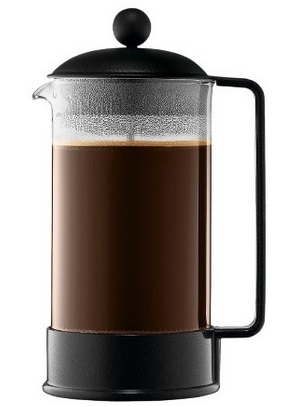
French Press Coffee Maker
Exotic Coffees
We have written about different ways to make coffee from around the world. None of these involves the internet or passwords and usernames. For example, Turkish coffee can be fun to make and is delicious as well.
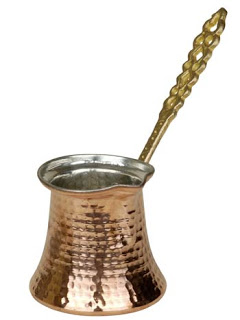
Ibrik for Turkish Coffee
Ibrik for Turkish Coffee
Here is the short and sweet approach to making Turkish coffee.
- When making coffee Turkish style grind the coffee beans even finer than you would for making espresso.
- Make Turkish coffee in a small pot with a cup of water
- A small sauce pan will do although Turks use an ibrik (see image)
- Add sugar
- Plain: no sugar
- Little sugar: add half a level teaspoon to the coffee
- Medium: add a level teaspoon to the coffee
- A lot of sugar: add two level teaspoons to the coffee
- Bring the water with sugar to a boil and remove from heat
- Add coffee and stir until coffee sinks
- Some add a pod of cardamom as well (optional)
- Heat again slowly until coffee boils and foam appears on the top
- So not stir as this disturbs the foam
- Do not boil too long as prolonged boiling gives the coffee a burnt taste
- Remove from heat briefly and then heat again
- Repeat one more time
- Pour coffee directly from the ibrik or your sauce pan into demitasse cups similar to what you would use for espresso
- Ideal Turkish coffee has a lot of thick foam (think of Cuban coffee) and the person who gets the cup with the most foam has the best coffee.
Get back to the basics of making coffee and forget about internet access for your coffee maker.
Organic Coffee with Antioxidants in It
Coffee is good for you and organic coffee is better. The healthiest part of organic coffee is the antioxidants in it. What are organic coffee antioxidants and why are they good for you?
Scientifically an antioxidant is a molecule that inhibits the cell damage and cell death in human cells caused by oxidative breakdown of other molecule in the cell. Oxidation is a factor in sickness and aging. Antioxidants help prevent the damage caused by excessive oxidation and to a degree inhibit the aging process. When an oxidative reaction brought on by disease gets going it produces free radicals that start chain reactions which in turn cause cell and tissue damage. The human body has or uses antioxidants to control this situation. Natural means of controlling oxidation include vitamins C and E as well as glutathione. It is low levels of antioxidants that can lead to a condition referred to as oxidative stress and resultant damage to cells in the body. Organic coffee antioxidants are in the same class of molecules that help reduce oxidation.
An example of a good antioxidant in organic coffee is methylpyridium. It is created during the roasting process from the chemical trigonelline in green coffee beans. It turns out that methylpyridium increases the activity of phase II enzymes in the human body and these enzymes are believed to protect against colon cancer, the second leading cause of cancer death in the USA.
Other Reasons to Drink Organic Coffee with Antioxidants in It
Organic coffee with antioxidants in it helps prevent degenerative diseases as we noted in our article Forget Your Alzheimer’s and Drink Your Coffee.
Regular and healthy organic coffee both contain caffeine and a number of other useful ingredients, one or more of which appears to reduce levels of beta amyloid in the brain. A study that the South Florida researchers published in the Journal of Neuroscience shows that Caffeine protects Alzheimer’s mice against cognitive impairment and reduces brain beta-amyloid production. The coffee drinking mice kept their memories! In addition, researchers found that high coffee consumption in mice raised levels of granulocyte colony stimulating factor, a chemical that has reduced levels in Alzheimer’s patients.
Alzheimer’s and Parkinson’s which coffee also helps prevent develop over time. Research has shown that drinking just one cup of coffee a day over the years is associated with a reduced incidence of Alzheimer’s and a lower risk of Parkinson’s as well. Add to this the significantly reduced incidence of Type II diabetes in coffee drinkers. With both Alzheimer’s and Type II diabetes the more coffee you drink the greater reduction you will see in incidence of these diseases. It all has to do with organic coffee with antioxidants in it.
Why Organic Coffee?
Organic coffee is typically high quality Arabica coffee. And because organic coffee is grown using sustainable agricultural practices it contains no pesticide, herbicide or fungicide residue. Organic coffee is grown with minimal use of synthetic fertilizers and has been shown to save you from more than 150 contaminants commonly seen in regular coffee.
Organic Coffee Market in the USA
The USA consumes more coffee than any other nation on the planet. Of the nations that drink the most coffee the USA ranks first followed by Germany, Japan and France. Of course the Dutch, Fins and Swedes drink more per capita but their populations are much smaller. How much of US consumption is organic coffee? The USA consumes nearly half of all organic coffee that is grown. The portion of US coffee imports that is certified as organic or fair trade is 16% of all green coffee according to Trends in Trade of Certified Coffee. The value of US organic coffee sales in the USA passed a billion dollars a decade ago according to the Organic Consumers Association.
Organic Coffee and K Cups
A substantial portion of US coffee comes from single servings, K cups or similar products. The efficiency of making just one cup is very attractive. And you can get organic coffee in single serving cups as well. But we asked this question last year, does organic coffee in a K cup make sense?
Keurig Green Mountain is coming out with a new product line, organic coffee in K cups. Our question is if organic coffee in a K cup makes any sense. People drink organic coffee because they like the taste and aroma of high quality coffee, they like the idea of a pure produce free of unnecessary contaminates and because they want to help protect the environment. Putting organic coffee in a K cup raises some questions but first a little about the new Keurig product line.
Billions of K cups go into landfills each year. If part of the reason you drink organic coffee is that you want to protect the environment then even organic coffee in a Keurig K cup is a problem. But there was a solution. Keurig also made refillable K cups under the brand, My K Cup. You could also refill these with any coffee of your choice, which would commonly be cheaper than the coffee from Keurig. Unfortunately that changed.
Unfortunately Keurig stopped that because they were losing business.
Coffee at the Coffee Shop
You can get organic coffee at shops like Starbucks which buys about 2 million pounds of organic green coffee beans each year. They also note that much of the high quality coffee that they buy is grown using organic methods but the grower does not go to the trouble of certifying because they sell their whole crop to Starbucks. Thus you are often getting organic coffee but not certified organic coffee at your local coffee shop.
Who Drinks Organic Coffee?
We found out in our article, Do Millennials Drink Coffee, that this age group prefers higher quality coffee.
It turns out that millennials do not necessarily drink more coffee than other generations of Americans, but they like good coffee and are willing to pay for it. In a world in which investments in the stock market and real estate have bottomed out right before our eyes, many millennials are “investing” in quality of life which includes better food and beverage experiences.
It is good news for the organic coffee business that this younger age group likes the product.
Should You Refrigerate Organic Coffee Beans?
Coffee is good for you and organic coffee is even better. The positive health effects of coffee primarily come from the antioxidants. And coffee is the biggest source of antioxidants in the foods and beverages that we eat both because coffee contains these great chemicals and because we drink so much coffee. In order to preserve the antioxidants in coffee should you refrigerate organic coffee beans? The answer is an emphatic no. Here is why.
What Should Go in the Frig or Freezer and What Should Stay Out
Foods that will spoil at air temperature like meats and poultry go in the freezer for long term storage and in the frig for a day or so. The food that you eat comes out, gets thawed and gets cooked. There is no spoilage, no food poisoning and everyone is happy. What you do not do with meat or poultry is to continue to repeatedly remove from the freezer or frig, allow to warm up, and then freeze again. You are risking food poisoning and to a degree are degrading nutritional value. The later issue is what applies to coffee as well as tomatoes, watermelon, onions and garlic.
Condensation Is an Enemy of Organic Coffee Antioxidants
Organic green coffee beans retain their freshness and antioxidants for up to two years if stored in a cool and dry place. Roasted coffee beans are good for up to six months, also if stored in a cool and dry place. If you have the exact quantity that you intend to grind and use to make coffee on the spot you could store that quantity in an air tight bag in the freezer or frig. What you cannot do without degrading antioxidants and losing freshness is to store a five pound bag of green, roasted or especially roasted and ground coffee in the frig or freezer. Then every time you take out the coffee and remove some to make coffee the warmer air in the room will cause condensation on the coffee beans. And it is this condensation that serves to degrade antioxidants and freshness.
Worse with Roasted and Ground Coffee
The effect of condensation on coffee antioxidants is quickest where the warm, moist air touches to cold coffee. If you are storing ground coffee first of all the best you can hope for by storing in a cool and dry location is six weeks before all the freshness and antioxidant value is gone. If you repeatedly cause condensation by removing from the frig and putting back in every little grain of roasted and ground coffee is effected each and every time. At least with whole beans the condensation effect only works on the outside of the bean and needs to work its way inward with time.
Healthy Coffee Does Not Go in the Frig or Freezer
If you want to enjoy the health benefits of coffee and make the taste and aroma last, do not refrigerate or freeze your coffee. Store your coffee in a cool and dry place in a sealed jar. This means do not put the coffee in the cupboard over the stove where the heat and humidity from cooking will negate everything that we have just said!