Coffee As Medicine: the Right Dose
We have written frequently about the benefits of regular and organic coffee for your health. More and more the world has come to realize the medical benefits of coffee, both the caffeine and antioxidants. Because we could think only of the health benefits of coffee, we should consider coffee as medicine and ask what is the right dose? Forbes seems to have been thinking along those same lines as they write about the right doses of coffee and alcohol.
The world’s most-used stimulant and best-loved depressant – caffeine and alcohol, respectively – have shared an interesting phenomenon in recent years: They’ve both moved from the probably-not-healthy-but-socially-acceptable category to the probably-healthy-in-moderation-because-science-says-so category. Based on the scientific evidence of the last decade or two, coffee is now believed to reduce risk of everything from Parkinson’s and Alzheimer’s diseases to depression to erectile dysfunction to some forms of cancer to overall mortality. Alcohol is thought to reduce the risk of heart disease, stroke, and perhaps even curb obesity and type 2 diabetes risk. Each drug has been shown to have these much-desired health benefits, and few risks, provided they’re consumed in moderation. The operative words are of course in moderation.
A study by the European Food Safety Authority indicates that 400 mg of caffeine a day, the equivalent of five shots of espresso is safe over the long run. Pregnant and breast feeding mothers should cut this in half. This is good news for coffee as medicine as a dose of four cups a day is where the health benefits are most pronounced.
The Goldilocks Approach
Not too little and not too much but just right is the moral of Goldilocks and the Three Bears. It would seem to fit with finding the right dose of coffee as medicine. The drawbacks of too much coffee include stomach upset, acid reflux and wakefulness at night. The drawbacks of too little coffee are that the many benefits mentioned in the Forbes article do not come into play. Some of the benefits of coffee such as alleviation of depression come from caffeine so one could simply drink a coca cola. But the antioxidants are what kick in to help prevent various forms of cancer and Type II diabetes so the four to five cups, equivalent to five shot of espresso is probably ideal.
Condition Specific Dose of Coffee
Women who report drinking four cups of coffee a day have the best reduction of diabetes incidence. Just one or two cups an hour in advance are sufficient to boost athletic performance. Research shows that more is a waste of time. If you are drinking coffee to stay awake while studying for finals all bets are off as you need to stay focused for as long as it takes. The downside is that if you consistently drink lots and lots of coffee you eventually need to sleep and may take a long time to wake up. And, the caffeine in excessive amounts is an acid stimulant and that can lead to ulcers and acid reflux.
Benefits of Drinking Coffee
Even The New York Times is jumping on the coffee band wagon with an article about coffee’s benefits. Here is a snippet of what they have to say.
Just last year, a systematic review and meta-analysis of studies looking at long-term consumption of coffee and the risk of cardiovascular disease was published. The researchers found 36 studies involving more than 1,270,000 participants. The combined data showed that those who consumed a moderate amount of coffee, about three to five cups a day, were at the lowest risk for problems. Those who consumed five or more cups a day had no higher risk than those who consumed none.
The author goes on to report research showing lower risk of cancer, depression, suicide, Alzheimer’s disease, Parkinson’s disease and Type II diabetes. In fact, recent studies show a reduced risk of death from all causes! So the benefits of drinking coffee including getting to drink it for more years!
Maximizing the Benefits of Drinking Coffee
CBS News reports on how to maximize the health benefits of coffee.
But heavy java drinkers beware: consuming coffee does come with diminishing returns. “There’s a U-shaped relationship, meaning if you have less than one or two cups a day, the benefits are weaker, but it also drops off if you have more than five or six cups a day,” Phillips said.
The point is that drinking three to five cups of coffee a days is good for you in many ways. Drinking a lot more is not any better and may even be associated with fewer benefits. Moderation in all things is required for the best benefits of drinking coffee.
Even the Grounds Are Good for You
Science World Report talks about the benefits in used coffee grounds.
New findings published in the ACS’ Journal of Agricultural and Food Chemistry examine how coffee-grounds are chock-full of rich antioxidants that can help provide some of the health benefits associated with our favorite morning beverage.
Coffee is naturally rich in a wide variety of antioxidants, including dietary phenolic compounds. Furthermore, previous studies have shown that coffee can even help to reduce the risk of Alzheimer’s disease, cardiovascular issues and numerous other health problems.
For the study, researchers specifically looked to figure out the total amount of phenolic content in the extracts of leftover coffee grounds.
Then, they used three different methods to release antioxidants from spent grounds and found high levels of phenols in the extracts, with somewhat higher levels in brewed coffee.
However, they have the potential to serve as additives to enhance the potential health effects of other food products, the scientists concluded.
Take a look at our article, Healthy Coffee Grounds, for more info on this subject. An interesting niche use of coffee grounds is as an ingredient for skin care products. Put the antioxidants directly on the skin and reduce sun damage as well the incidence of cellulite. These may not be benefits of drinking coffee but by saving the grounds instead of sending them to the landfill we can use this source of antioxidants for healthy purposes instead of losing them.
More Coffee Linked to Longer Lasting Erections
And there is one more benefit of regular and healthy organic coffee. More coffee is linked to longer lasting erections! Forbes reports on a study published in the journal PLOS ONE. Coffee consumption is linked to decreased erectile dysfunction. That is to say if a man drinks more coffee he is more likely to be able to maintain an erection for the time desired.
According to a new study out in the journal PLOS ONE, caffeine intake is linked to reduced odds of having erectile dysfunction (ED) in men who drink the equivalent of two to three cups of coffee per day. Among the lifestyle factors that are known to put a man at risk of ED – poor diet, physical inactivity, smoking, and alcohol consumptions – caffeine has not been of the biggest candidates. But the new study suggests that like other areas of physical and mental health, ED may be another beneficiary of caffeine’s fascinating benefits. Since erectile function, and dysfunction, is in some ways an extension of cardiovascular health – and caffeine is known to have certain cardiovascular benefits – the idea that it could also help ED may not be so surprising. But for men who are devout coffee drinkers, the results may come as good news.
The odds of a man having difficulty maintaining an erection for the desired length of time is about 44 percent for men age 40 and over. For men over 70 the incidence of erectile dysfunction is 70 percent. So, just how much does coffee help?
What Is the Benefit of Coffee?
Researchers found that the caffeine equivalent of two to three cups of coffee a day were roughly forty percent less likely to have erectile dysfunction than those who do not drink coffee. The scientists believe that the benefit comes from caffeine. The benefit works for men who are overweight or frankly obese as well as men with hypertension, common reasons for erectile dysfunction. The caffeine in coffee does not help if erectile dysfunction is causes by diabetes, but coffee itself can help prevent diabetes!
Coffee and Diabetes
We have known for years that more coffee leads to less diabetes.
Drinking coffee reduces the incidence of Type II diabetes, the type that affects 95% of people with the disease. This has been known for some years but until recently no one really knew why. Now researchers at UCLA have found what may be the reason. It turns out that there is a protein called sex hormone-binding globulin. Its normal job is to regulate sex hormone activity in the human body. Researchers have long suspected that the same hormone has an effect on the development of Type II diabetes. How does organic coffee come into the picture? Drinking coffee increases the body’s levels of sex hormone-binding globulin. The American Diabetes Association says that nearly 24 million Americans have diabetes of which more than 9 in 10 have the Type II variety. That comes to roughly 22 million people with Type 2 diabetes. The fact that more organic coffee can lead to less diabetes could be a significant issue in US public health.
So, not only does more lead to longer lasting erections but it can prevent type II diabetes, a cause or erectile dysfunction!
What Does Organic Mean?
Coffee is good for you and organic coffee is better. Regarding coffee, just what does organic mean? Here is a primer on healthy organic coffee.
Organic Coffee
Organic coffee is grown with the addition of artificial substances such as synthetic fertilizers, herbicides, insecticides or fungicides. Organic coffee is also processed and stored separate from other non-organic produce. To obtain organic coffee certification a grower must abide by several restrictions. Fertilizers must be one hundred percent organic. Such fertilizers include chicken manure, coffee pulp and general compost. Three fourths of all organic coffee is grown in Latin America.
Preserving the Environment
Organic agriculture can strengthen the natural environment’s resistance to disease. Organic coffee is commonly shade-grown. This helps preserve forests and provides habitat for birds. Soil erosion is minimized and the water table is spared the polluting effects of synthetic fertilizers, herbicides, fungicides and insecticides. Insect populations are more balanced and less likely to case plant disease.
Organic Means Cleaner Coffee
A study by the Australian Food Standards Authority revealed that as many as 133 contaminants may be in a cup of commercially available coffee. These contaminants include metals such as aluminum and zinc, pesticide residues, ochratoxin A, acrylamide, furan, and polycyclic aromatic hydrocarbons. Some polycyclic aromatic hydrocarbons are found to cause cancer. Furans have been associated with skin disorders, liver problems, certain kinds of cancers, impairment to the reproductive, endocrine, and immune system, as well as effects on embryonic development. What does organic mean? It means a cleaner cup of coffee with no harmful additives.
Coffee Is Good for You
Coffee is good for you. So don’t take away from the benefits by adding things that are bad for you. Coffee drinkers get less type II diabetes.
Women who drink at least four cups of coffee a day have less than half the incidence of Type II diabetes as women who do not drink coffee. The coffee drinkers all had elevated sex hormone-binding globulin levels while the non coffee drinkers did not. The relationship was complete between the elevated enzyme level and a reduced incidence of Type II diabetes.
The American Diabetes Association says that nearly 24 million Americans have diabetes of which more than 9 in 10 have the Type II variety. That comes to roughly 22 million people with Type 2 diabetes. The fact that more organic coffee can lead to less diabetes could be a significant issue in US public health.
Drink coffee and reduce your risk of this disease.
And coffee reduces the risk of diseases like colon cancer.
It turns out that one of the antioxidants obtained during the process of roasting organic coffee may well reduce the risk of getting colon cancer, the second leading cause of cancer death in the USA. For many years medical researchers have known that a set of enzymes in the human body, phase II enzymes have a protective effect. They help us avoid getting colon cancer. The higher the level of phase two enzymes you have the lower your risk is of getting colon cancer. Here is where a good cup of organic coffee comes in. The methylpyridium produced as a natural byproduct of roasting organic coffee raises phase II enzyme levels. In fact more coffee means more methylpyridium which means higher levels of phase II enzymes. Medical studies are underway to determine the precise amount of methylpyridium that would be recommended.
What does organic mean? It means healthy, good tasting safe-for-you coffee!
Marijuana Coffee
Who would have thought, marijuana coffee is now commercially available. Of course you need to be in a state where selling cannabis and cannabis products is legal. Think of marijuana coffee as a variant on liqueur coffee, something to relax you and something to pep you up in the same cup. Fox News reports on marijuana-infused coffee pods.
Cannabis-infused coffee is now available in convenient single-use pods for those who want a little more buzz to their a.m. jolt.
Seattle-based Uncle Ike’s Pot Shop now sells pods of premium Catapult coffee at a steep $10 per pod. Each pod works in standard, single-serve coffee makers and contain 10 mg of THC, marijuana’s psychoactive ingredient. The shop previously sold loose grounds infused with marijuana but the pods are “quickly becoming big sellers,” said the shop.
“I liken it to a Red Bull and vodka,” Jennifer Lanzador, Uncle Ike’s sales manager, told Yahoo. “I had more energy, but I still had the relaxation you get from cannabis.”
Fairwinds Manufacturing, the Vancouver company that actually makes the pods for Uncle Ike’s, reported that the pods now account for 60 percent of company sales.
House of Jane in California has four types of cannabis K-cups: medium roast, dark roast, decaf and mocha café. It also sells marijuana infused coffees, teas and creamers-one of which recently won a best-edible award at one of the world’s largest medical marijuana trade shows HempCon. It is also working on cannabis-infused “Frappuccino”-the drink will not be sold at Starbucks but the team hopes to capitalize on the popularity of the well-known creamy beverage during the hot summer months.
What will be next, Irish coffee in k-cups? Just make sure that it is organic!
Where Is Marijuana Coffee Legal?
The New Health Guide lists where marijuana is legal. The categories are as follows:
Light Green: State with legal medical cannabis
Medium Green: State with decriminalized cannabis possession laws
Dark Green: State with both medical and decriminalization laws
Purple: State with legalized cannabis
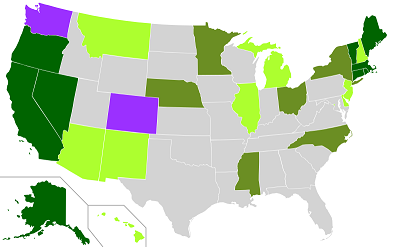
If you want marijuana coffee your best bets are Washington and Colorado. In small quantities you might be able to get buy in the rest of the West Coast but you might want to ask your lawyer before bringing a case full of marijuana coffee K-cups across the border to neighboring states!
OK in LA
According to the LA Weekly it is 100 percent legal to buy weed-infused coffee in L.A.
The aroma hits you as soon as you pop open the black zip-top bag.
These are heirloom Ethiopian Yirgacheffe “Zero Defect” coffee beans – so-called because they’re triple-sorted until measured to have less than one defect per 300g. But after taking a huge whiff, all that comes to mind is Dude, this smells like super dank weed.
Kian Abedini, owner and roastmaster of L.A.-based coffee company Compelling & Rich, gives a knowing smirk. “You really get the cannabis notes when you brew a cup,” he explains. “Take a sip, breathe out and you can taste the skunkiness on your breath.”
Weed and coffee, a combination sometimes called “the hippie speedball” or “‘spro and ‘dro,” have a long and stimulating history together. Not long after pot was legalized in Washington and Colorado, baristas were already hard at work finding ways to combine their love of beans with their love of bud, producing concoctions such as weed butter “bulletproof” coffee and THC-spiked cold brew. On a trip to Denver for the Big Western Regional Coffee Championship last year, Abedini was hanging out with industry friends wondering why, among the existing weed-coffee products out there, none captured the actual taste of the combination. What if there was a way to flavor the beans with cannabis?
Who would have thought, marijuana coffee in the land of dreams?
Healthy Coffee Grounds
Not only are there good things in healthy organic coffee, the grounds are healthy too. Unfortunately coffee grounds usually go down the garbage disposal or into the landfill. With hope that some of the benefits of the byproducts of making a cup of coffee can be made use of, here is a bit about healthy coffee grounds.
All about the Antioxidants
UPI reports that researchers at the University of Granada in Spain have looked at coffee byproducts and found that a large amount of regular and organic coffee antioxidants remain with the grounds after you make your coffee.
Researchers from the University of Granada found that antioxidant levels in spent coffee grounds and coffee silver skin are especially high. The silver skin is one of the protective layers in between the outer coffee berry and the beans inside; it is typically removed prior to roasting.
Some consumers use spent coffee grains as a do-it-yourself exfoliant. Others deposit coffee grounds into their compost pile. But the vast majority of coffee byproducts make their way to the landfill.
That’s a shame, according to researcher and food science professor Jose Angel Rufian Henares. Henares’ research team found silver skins and used coffee grounds to be rich in fiber and phenols, and to have antimicrobial and antioxidant properties 500 times greater than vitamin C.
Researchers hope that their findings will inspire food producers and others to devise ways to recoup these healthy coffee grounds and make use of them in healthy products.
Coffee Grounds for Skin Care
Someone is already taking advantage of the benefits of healthy coffee grounds. According to Florida Today, Star Beauty Products turns coffee grounds into skin care products.
Star Body Beauty Products, recycles espresso grounds and converts them into a variety of skin care products, including facial and body scrubs, soaps, lotions and bronzing balms.
The company’s founder, Barbara Mekolites-Marich, said she started manufacturing recycled coffee beauty products because she wanted to simultaneously reduce the amount of waste that goes into landfills and produce organic, caffeine-infused cosmetics.
Some medical research indicates that topical caffeine products reduce inflammation, reverse sun damage, provide antioxidant protection and minimize the appearance of cellulite. Although those scientific theories have not been definitively proven, they are causing some women to add caffeine skin products to their beauty regimen.
Star Body Beauty Products is a green company that uses reusable packaging gets its coffee grounds from local coffee houses.
Why Antioxidants?
What is the point about antioxidants? That is, why should we want to recover them from healthy coffee beans? Scientifically an antioxidant is a molecule that inhibits the cell damage and cell death in human cells caused by oxidative breakdown of other molecule in the cell. Oxidation is a factor in sickness and aging. Antioxidants help prevent the damage caused by excessive oxidation and to a degree inhibit the aging process. When an oxidative reaction brought on by disease gets going it produces free radicals that start chain reactions which in turn cause cell and tissue damage. The human body has or uses antioxidants to control this situation. Natural means of controlling oxidation include vitamins C and E as well as glutathione. It is low levels of antioxidants that can lead to a condition referred to as oxidative stress and resultant damage to cells in the body. Organic coffee antioxidants are in the same class of molecules that help reduce oxidation.
Espresso in Space
The fondest wish of Italian astronaut, Samantha Cristoretti, was to have a cup of espresso during her sojourn on the International Space Station. An Italian made espresso machine arrived on the most recent supply ship and now there is espresso in space. The RT website reports on how real coffee hits space.
Last month, the Dragon spacecraft, built and operated by SpaceX, delivered the first-ever space espresso machine, built by Italian coffee company Lavazza and Italian aerospace firm Argotec, to the space station, along with special, zero-gravity cups. Prior to the coffee machine’s long-awaited arrival, the only option aboard the orbiting laboratory was powdered instant coffee. The cups, co-designed by International Space Station researcher Mark Weislogel and astronaut Don Pettit, are peculiarly shaped so that a sharp corner makes the liquid inside stream toward a person’s mouth when they drink from it.
At last there is espresso in space. If there is an Irish astronaut will Irish coffee be next?
Espresso in Space
The Nasa.gov website reports that the espresso machine in space is about the size of one on earth.
ISSpresso is not much larger than a typical Earth-based espresso machine, and produces espresso, broth or tea.

Making espresso in space is fantastic but how about drinking it from a cup?
The Zero Gravity Coffee Cup
Liquids act strangely in zero gravity. They float around like blobs. NASA Science explains the zero gravity coffee cup.

High above our planet in the realm of satellites and space stations, the familiar rules of Earth do not apply. The midday sky is as black as night. There is no up and no down. Dropped objects do not fall, and hot air does not rise.
Of all the strange things that happen up there, however, it is possible that the strangest happens to coffee.
Physics professor Mark Weislogel of Portland State University has given a lot of thought to coffee (and other fluids) in space, and he describes what happens:
“For starters,” he says, “it would be a chore just getting the coffee into the cup. Absent the pull of gravity, pouring liquids can be very tricky.”
[BUT] If two solid surfaces meet at a narrow-enough angle, fluids in microgravity naturally flow along the join-no pumping required. This capillary effect could be used to guide all kinds of fluids through spacecraft, from cryogenic fuel to recycled waste water. The phenomenon is difficult to study on Earth, where it is damped by gravity, yet on the space station large scale corner flows are easy to create and observe.
Basically, one side of the cup has a sharp interior corner. In the microgravity environment of the space station, capillary forces send fluid flowing along the channel right into the lips of the drinker.
“As you sip, more fluid keeps coming, and you can enjoy your coffee in a weightless environment – clear down to the last drop,” says Pettit. “This may well be what future space colonists use when they want to have a celebration.”
The photos are of the zero gravity coffee up uniquely designed for drinking espresso in space and the zero gravity espresso maker.
Single Serve Decreases Coffee Consumption
We recently addressed the issue of who drinks the most coffee and it is the USA. Now it would appear that the USA is steadily consuming less coffee, not because anyone is cutting back but because of the single serve revolution. Bloomberg Business reports on how single-serving pods have decreased coffee consumption.
Single-serve brewing machines popularized by Keurig Green Mountain Inc. are now used by more than one in four Americans and are altering the way coffee is consumed. Almost every brand, from Folgers to Dunkin’ Donuts, is sold in disposable 2-inch-by-2-inch plastic pods that yield just one serving. They’re more efficient than drip-brewing pots capable of making 10 cups, some of which isn’t consumed and gets dumped.
While Americans still drink more coffee than any beverage except water, expanded use of single-serve machines has slowed demand growth for a $52 billion market in the U.S., the world’s biggest consumer. That’s hurt sales at a time when ample inventories of the commodity have sent prices tumbling.
One observer says that coffee farmers have lost their most lucrative consumer, the kitchen sink where unused coffee poured.
Who Started Single Serve?
Keurig is an American manufacturer of coffee brewers and producers of K-cups.
Each K-Cup is a plastic container with a coffee filter inside. Ground coffee beans are packed in the K-Cup and sealed air-tight with a combination plastic and foil lid. When the K-Cup is placed in a Keurig brewer, the brewer punctures both the foil lid and the bottom of the K-Cup and forces hot water under pressure through the K-Cup and into a mug or cup.
From small beginnings this single serve revolution has moved into one in four US homes as well as offices and hotel rooms.
And Lots of Plastic
Those of us who like healthy organic coffee also care about the environment. As single serve decreases coffee consumption it should be a good thing. But the single serve plastic pods are an environmental disaster according to the Montreal Gazette.
The increasing popularity of single-serve coffee brewing technologies is not only decreasing overall demand for coffee in North America, but also producing colossal volumes of un-recyclable and non-compostable plastics. While the efficiency of these machines (which help reduce coffee waste) can be seen as an improvement from conventional methods of brewing coffee, arguably, this is offset by the excessive plastic waste generated from their use. Not to mention the amount of fossil fuels used and burned in creating the plastic cups. The amount of coffee wasted from old-fashion coffee machines could be mitigated through a fundamental shift in the North American economic system. If coffee prices included environmental externalities, they would undoubtedly rise and consumers would be more economically inclined not to waste their precious coffee.
If you like organic coffee and are friendly to the environment consider buying whole bean roasted coffee, grinding just enough before making coffee and enjoying fresh coffee every time. Along the way you will not be cluttering up the world with single serve plastic containers.
The Biology of Shade Grown Organic Coffee
Coffee has lots of great health benefits and healthy organic coffee is the best as going organic helps you avoid more than a hundred impurities that can be found in cup of regular coffee. We know that certified organic coffee is better for the environment as organic coffee farming follows sustainable practices. These practices for coffee include interspersing coffee among shade trees to secure the soil and provide shade for coffee plants. The use of commercial fertilizers is limited and pest control requires natural practices as opposed to chemical insecticides and fungicides. All of this sounds very straightforward from a distance but just what is the biology of shade grown organic coffee? Why does coffee like the shade? Why does coffee grow best in mountainous terrain under cloud cover? Here are a few thoughts about the biology of shade grown organic coffee.
Where Coffee Originated
Coffee evolved in the forested highlands of East Africa (Ethiopia, Eritrea and Sudan). Here is where the plant became accustomed to the seasons, degree of rainfall, soil conditions and pests. From an evolutionary viewpoint coffee has arrived way to fast in various locations around the world and cannot be expected to adapt without some forethought and help in its new locations such as Brazil, Colombia or Vietnam. Nevertheless coffee is planted and flourishes in these locations. And coffee does best where the conditions are similar to where it grew up. The biology of shade grown organic coffee is such that growing coffee in the shade resembles how the plant was meant to grow.
Basic Plant Biology and the Coffee Perspective
Plants use photosynthesis to convert sunlight to energy and along the way convert carbon dioxide in the air in order to grow and exhale oxygen. Plants need nitrogen, potassium, phosphorus and other nutrients. And if they get too much of these and if they get too much sun light they need huge amounts of water as well. But too much water can drown the roots of a plant, including a coffee plant and make it sick. Thus there is an advantage to the biology of shade grown organic coffee in that the terrain of the mountainside keeps water from flooding the plant and the forest canopy limits the amount of sunlight powering growth. Organic coffee farming uses less of the chemicals that fuel growth but also uses an appropriate amount so that the plant does not need excessive amounts of water.
Location, Location, Location
Picking the spot for growing Arabica coffee is a lot like dealing with real estate, location, location and location. Arabica organic coffee likes a temperature range between 15 and 24 degrees Celsius. (That’s 59 degrees to 75 degrees Fahrenheit.) This sort of temperature range is found in the land of eternal spring along the mountainous spine that runs from southern Mexico to Ecuador and Brazil. Soil quality and soil management are important but it starts with an ideal location and ideally a shady one.
Avoidance of Coffee Leaf Rust
The fungal disease that can devastate coffee crops is more prevalent where coffee is planted too closely together, when they are planted in full sun and where it is planted in warmer locations. Growing organic coffee under forest cover at higher altitudes is a better approach if you want to avoid coffee leaf rust than planting tightly spaced coffee at lower altitude in full sun.