Why Buy Arabica Coffee
Why buy Arabica coffee? If you are looking for a pick me up, robusta coffee beans contain more caffeine than Arabica beans. And Robusta coffee futures are sitting at around $1.10 a pound while Arabica futures are more than $2 a pound for lowest quality Arabica beans. So why buy Arabica coffee? People buy Arabica coffee because it tastes better and has a better aroma. Arabica is higher quality coffee than Robusta. Now the question is where do you get your Arabica coffee?
Colombian Organic Coffee
We are, by the way, an organic coffee site. The best coffee is Arabica and the best Arabica is organic from Colombia. Here is a little info about Brands of Organic Coffee from Colombia. Colombia produces the second largest amount of Arabica coffee in the world, second only to Brazil. Brazil is experiencing a drought and expected to see decreased production. Colombia has recovered from the effects of the 2008 el Niño and expects to see a record harvest. Colombia’s production is forecast up 1.0 million bags to 12.0 million on higher yields. With the increase in overall coffee production in Colombia one can expect an increase in organic production as well. Wholesale organic green coffee from Colombia is some of the best Arabica coffee in the world.
Wholesale Organic Arabica Coffee
Colombian coffee is the best Arabica coffee in the world. There are several outstanding Colombian organic coffee brands. Here is a short list of folks in the Cafetero who can provide organic wholesale coffee in quantity.
Volcan
Linea Roja
Sostenible
Origen
Oma
Frailes
Juan Valdez
Café Madrid
Fincas Aliadas
Tolima
Eco Bio Colombia
Asprounion
Mountain View Coffee
Café Pitayo
Why Colombia?
Colombia ranks behind the larger country of Brazil in coffee but Colombia is the best producer of high quality Arabica coffee. To get organic wholesale coffee from Colombia you need to deal with a professional exporter because of issues unique to Colombia, namely a sixty year long civil war. Colombia’s civil war began in the 1950’s and is still going. What began as a fight for the rights of small farmers has largely turned into paramilitary groups of drug lords and mini drug lords and kidnappers hiding out in the jungle with little chance of reintegrating into society. The government has gotten the rebellion out of the cities but the surviving drug lords in the jungle still try to ship their product out of the country by various means. If you need help getting high quality organic Arabica coffee feel free to contact us at www.BuyOrganicCoffee.org. We will be pleased to find the coffee you want and need and to arrange export and shipping. Don’t worry about not speaking Spanish. We will deal directly for you with folks in the Eje Cafetero, the Colombian coffee growing district. Why buy Arabica coffee? It is the best. And the best of the best is organic Arabica coffee from heart of Colombia. Contact us today for more information.
How Much of the Cost of a Cup of Coffee Are the Beans?
How much of the cost of a cup of coffee are the beans? This question comes to mind as the price of Arabica coffee goes up again. We wrote previously that the Brazil drought drives coffee prices higher. But if the price of coffee beans goes up ten percent does the cost of your coffee go up by the same percent or the same number of cents? The United States Department of Agriculture published an article about the cost pass-through in the coffee industry. We found it published at Colombia.edu.
A rich data set of coffee prices and costs was used to determine to what extent changes in commodity costs affect manufacturer and retail prices. On average, a 10-cent increase in the cost of a pound of green coffee beans in a given quarter results in a 2-cent increase in manufacturer and retail prices in that quarter. If a cost change persists for several quarters, it will be incorporated into manufacturer prices approximately cent-for-cent with the commodity-cost change. Given the substantial fixed costs and markups involved in coffee manufacturing, this translates into about a 3-percent change in retail prices for a 10-percent change in commodity prices. We do not find robust evidence that coffee prices respond more to increases than to decreases in costs.
Thus there is an eventual thirty percent pass-through in the cost of green coffee beans to a bag of roasted coffee beans. This tells us how much of the cost of coffee are the beans.
Organic versus Regular Coffee
The price of coffee is going up because of the drought in Brazil. The bountiful harvest in Colombia is not enough to pick up the slack. But, other factors come to bear on the price of organic coffee and the market price of healthy organic coffee beans. The problem with organic coffee production is not drought but heat. Coffee leaf rust usually does not infect coffee grown at altitudes higher than 6,000 feet. This is because the fungus cannot tolerate the low nighttime temperature usually found at that altitude. But, as temperatures climb just a few degrees in the nighttime in Central and South America the fungus is creeping up the slopes to where organic coffee is commonly grown. The issue with organic coffee is that there is a lot less of it than regular coffee. Although the cost to put a bag of organic coffee on the shelf of a store in North America only goes up thirty percent of the percent rise in the cost of coffee beans the scarcity of organic coffee will tend to drive prices higher. This is the age old law of supply and demand. Eventually other producers will catch on to what Colombia has done. They will replant with leaf rust resistant strains. This will allow coffee production and especially organic coffee production to rise again and help bring down prices. In the meantime expect to pay more for organic coffee beans.
Wholesale Organic Green Coffee from Colombia
Coffee production in Colombia is returning to pre-2008 levels. We noted this fact in our article Wanted: Coffee Pickers in Colombia. The June 2014/15 USDA forecast illustrates this fact with a graph.

Colombia Coffee Production
Colombia’s production is forecast up 1.0 million bags to 12.0 million on higher yields. Continued growth is expected following 7 years of below -average output due to the spread of coffee rust and coffee cherry borer insect. The rust initially affected as much as 40 percent of the planted area, but has since declined to less than 10 percent following an aggressive tree renovation program. Colombia is expected to rely on imported beans from Ecuador and Peru for just one-third of consumption, down from nearly 85 percent a few years ago. Bean exports are forecast to gain 300,000 bags to 10.5 million on increased shipments to the United States and Europe.
With the increase in overall coffee production in Colombia one can expect an increase in organic production as well. Wholesale organic green coffee from Colombia is some of the best Arabica coffee in the world.
Colombian coffee is the best Arabica coffee in the world. There are several outstanding Colombian organic coffee brands. Here is a short list of folks in the Cafetero who can provide organic wholesale coffee in quantity.
Volcan
Linea Roja
Sostenible
Origen
Oma
Frailes
Juan Valdez
Café Madrid
Fincas Aliadas
Tolima
Eco Bio Colombia
Asprounion
Mountain View Coffee
Café Pitayo
Why Colombia?
Colombia is a major coffee producer ranking behind the larger country of Brazil in coffee volume produced. But Colombia is the best producer of high quality Arabica coffee in volume for shipping organic wholesale coffee. To get organic wholesale coffee from Colombia you need to deal with a professional exporter because of issues unique to Colombia, namely a sixty year long civil war. Colombia’s civil war began in the 1950’s and is still going. What began as a fight for the rights of small farmers has largely turned into paramilitary groups of drug lords and mini drug lords and kidnappers hiding out in the jungle with little chance of reintegrating into society. The government has gotten the rebellion out of the cities but the surviving drug lords in the jungle still try to ship their product out of the country by various means. So, if you are going to fly out of Manizales, Pereira, Medellin, Cali, or Bogotá expect to have your bags searched for drugs as a large drug-sniffing police dog sits by. The office will pin prick any bags of coffee that you are carrying and test with a mechanical “sniffer” if not the large pooch at his side. If you decide that you would like to forego this experience and mail your coffee back home forget it. You cannot mail packaged coffee out of Colombia! If you are interested in Colombian organic coffee brands you need to carry the coffee out yourself or deal with someone who exports Colombian organic coffee brands. For more information about Colombian organic coffee brands feel free to contact us at https://buyorganiccoffee.org/contact-us/.
Less Ringing in Your Ears with Coffee
There are all sorts of wonder health benefits from drinking coffee, especially healthy organic coffee. Now there is another benefit. It appears that you get less ringing in your ears with coffee consumption. This info comes from a prospective study derived from the Nurses’ Health Study II. Nurses’ Health Study II
was established by Dr. Walter Willett and colleagues in 1989 with funding from the National Institutes of Health. The primary motivation for developing the Nurses’ Health Study II was to study oral contraceptives, diet and lifestyle risk factors in a population younger than the original Nurses’ Health Study cohort.
Over the years a wealth of useful information has come from follow-ups on this group.
Less Ringing in Your Ears with Coffee
According to info published by the researchers in Nurses’ Health Study II, caffeine was originally thought to cause tinnitus, also called ringing in the ears. In order to test this hypothesis the researchers looked at the reports from 65,085 women aged 30 to 44 in the study group as of 1991. Information regarding ringing in the ears, tinnitus, was obtained from 2009 reports. Eighteen years after the initial baseline info was obtained more than 5000 women reported some degree of ringing in the ears. Interestingly the relationship to drinking coffee was opposite what common wisdom had predicted. Women who reported drinking two and three cups of coffee day had a significantly lower incidence of this condition that women who drank a cup of coffee a day or less. The conclusion of the report was that women who drink coffee have a lower incidence of ringing in the ears that those who do not. The study did not include men and did not address organic versus regular coffee.
One More Good Reason to Drink Coffee
This is just one more good reason to drink coffee. We have reported on these pages how coffee reduces the risk of type II diabetes, prostate cancer, endometrial cancer and colon cancer. Scientific evidence indicates that drinking coffee reduces your risk getting Alzheimer’s disease, Parkinson’s disease, depression or cirrhosis of the liver. We even noted that coffee may make sex better!
Does coffee make sex better? Interestingly scientific research shows that coffee can lead to sexual arousal in females. Studies of sixtyish men and women show that coffee drinking women have sex more frequently and coffee drinking men have higher potency. A common sense finding is that coffee gives you a physical and mental boost that can carry over into more energy when making love. We posed the question last week, does coffee improve athletic performance. It turns that coffee does help. So, if your sex is of the athletic variety so much the better! And, better health is commonly synonymous with better sex. Both regular and healthy organic coffees have lots of health benefits.
So, drink up and enjoy both taste and aroma of the brew and the fact that coffee can help you in lots of ways.
Vitamins in Coffee
The caffeine in healthy organic coffee wakes you up, reduces your risk of depression, improves athletic performance, increases sexual appetite in women and enhances sexual performance in men. Organic coffee antioxidants help reduce the risk of type II diabetes and several kinds of cancer. Now, it turns out that there are vitamins in coffee as well.

Vitamins in Coffee
Vitamins in Coffee
Here are the vitamins and minerals that you get with an eight ounce cup of coffee. These are in terms of RDA. RDA stands for recommended daily allowance.
Thiamine (Vitamin B1) 2%
Riboflavin (Vitamin B2) 11%
Pantothenic Acid (Vitamin B5) 6%
Folic Acid (Vitamin B9) 1%
Magnesium 2%
Manganese 3%
Niacin (B3) 2%
Phosphorus 1%
Potassium 3%
Assuming that you drink more than one eight ounce cup of coffee a day you can multiply the percent of RDA per cup by the number of cups to get the total RDA of vitamins in coffee that you receive every day.
What These Vitamins and Minerals Do For You
Thiamine: As a co-enzyme that is involved in complete carbohydrate, protein and fat breakdown for energy. Chemical reaction pathways in our mitochondria allow for electrons to be removed from involved molecules and they are carried to electron transport chains found in the mitochondria membrane. The carriers are niacin and riboflavin based blueprints and constructing proteins.
Riboflavin: Vitamin B2, also called riboflavin, is one of 8 B vitamins. All B vitamins help the body to convert food (carbohydrates) into fuel (glucose), which is “burned” to produce energy. These B vitamins, often referred to as B complex vitamins, also help the body metabolize fats and protein. B complex vitamins are necessary for healthy skin, hair, eyes, and liver. They also help the nervous system function properly. In addition to producing energy for the body, riboflavin also works as an antioxidant by fighting damaging particles in the body known as free radicals.
Pantothenic Acid: In addition to playing a role in the breakdown of fats and carbohydrates for energy, vitamin B5 is critical to the manufacture of red blood cells, as well as sex and stress-related hormones produced in the adrenal glands, small glands that sit atop the kidneys. Vitamin B5 is also important in maintaining a healthy digestive tract, and it helps the body use other vitamins, particularly B2 or riboflavin. Your body needs pantothenic acid to synthesize cholesterol.
Folic Acid: Folic acid is used for preventing and treating low blood levels of folate (folate deficiency), as well as its complications, including “tired blood” (anemia) and the inability of the bowel to absorb nutrients properly. Folic acid is also used for other conditions commonly associated with folate deficiency, including ulcerative colitis, liver disease, alcoholism, and kidney dialysis. Women who are pregnant or might become pregnant take folic acid to prevent miscarriage and “neural tube defects,” birth defects such as spina bifida that occur when the fetus’s spine and back do not close during development.
As you can see there are good vitamins in coffee in addition to the many other healthy features that coffee offers.
Wanted: Coffee Pickers in Colombia
There was an interesting item on the TV news last night out of Bogotá. In Manizales in the heart of the Eje Cafetero (the Colombian coffee growing axis) they are concerned that there will not be enough coffee pickers in Colombia for what is shaping up to be a record harvest. The Colombian coffee harvest suffered badly in 2008 when much of the crop was damaged by rain in an El Niño year. And the crop that year suffered a further forty percent loss to la roja, coffee leaf rust. Since that time Colombia has replanted extensively and recovered from the leaf rust with only a five percent crop loss last year. This year total Colombian coffee harvest is expected to come in at record levels. This is some relief for the coffee market as a Brazil drought drives prices higher. Of course, a record Colombian coffee harvest requires more than the usual number of coffee pickers in Colombia. When the hillsides of the Cafetero turn red with ripe berries, individual harvesters must move among the adjacent plants and trees to harvest shade grown organic coffee. Coffee is grown on slopes as steep as 70 degrees. (Think of this as mountaineering with a bag of coffee beans slung over your shoulder.)
More than Just Picking Everything in Sight
There is a skill set required for picking coffee beans. They must be ripe and not overly ripe. The berries must be removed without damaging the plant. This is not a mechanical operation but rather the work of skilled pickers who know their craft and are in excellent physical condition. After coffee is picked the beans need to be dried. This can be done on flat areas in full sun or in mechanical driers. The beans need to be adequately dried in order to avoid spoilage so the job needs to be done in a timely fashion. Otherwise spoiled coffee beans aptly called stinkers ruin the batch. And for a coffee farmer who has a mixed crop of regular coffee and healthy organic coffee the two types must be kept separate from the moment the beans are harvested through all processing and storage to comply with organic coffee certification requirements. So the request on the Bogotá news for more coffee pickers in Colombia extends to folks with other important skill sets as well.
The Intended Result
It is a long way from the mountains around Manizales, Colombia to your kitchen table. The intended result of carefully tending coffee crops, picking shade grown organic coffee at the right time, carefully drying and roasting to perfection is an excellent cup at breakfast or whenever you desire. For more current information about Colombian organic coffee brands and especially wholesale organic coffee contact us at Buy Organic Coffee at your convenience. In the meantime we will be talking to our suppliers in Colombia and elsewhere to see how the crop is doing and if they have found enough coffee pickers to guarantee an excellent cup or organic coffee on your breakfast table.
Organic Coffee Threatened
We have written previously about the dilemma that organic coffee growers face when coffee leaf rust infects their crops. Now Bloomberg has taken notice. In an article entitled Organic Coffee Threatened by Global Warming-Stoked Fungus the news organization discusses how growers are faced with spraying and losing their organic status or not spraying and losing their coffee plants.
Teodomiro Melendres Ojeda, an organic coffee grower in Cajamarca, Peru, stands at a crossroads. Neither path is attractive.
Leaf-rust fungus, known as roya in Spanish, has devastated about a third of his crop. Melendres, 48, can use chemicals to kill it, though he risks forfeiting his organic certification and the 10 percent price premium it brings. Or he can preserve the certification and watch his plants die.
What are the possible remedies for organic coffee growers to this spreading coffee plague?
Colombia Beats La Roya
Leaf rust, called la roya in Spanish, requires night time temperatures above 50 degrees Fahrenheit to thrive. This usually kept the disease below about 3000 foot elevation. It also likes more rain. When el Nino hit Colombia in 2008 it provided the rain and higher mountain temperatures allowed the fungus to thrive at altitudes up to 6,000 feet. Colombia lost forty percent of its Arabica coffee crop that year. The Colombian Coffee Growers Association started cross breeding studies in the early 1980s and has two strains of Colombian leaf rust resistant coffee, Colombian and Castillo. The first is a cross between an old Colombian variety, Caturra, and a rust-resistant strain from Southeast Asia, the Timor hybrid. Castillo is an offshoot of further cross breeding of the first Colombian leaf rust resistant coffee strain. Replanting with Colombian leaf rust resistant coffee in Colombia has reduced the incidence of leaf rust from 40% to 5% from 2011 to 2013. However, to accomplish this, the Colombians needed to uproot forty percent of their coffee crop and replant. This is what organic growers are facing all across Latin America.
What Is an Organic Coffee Farmer to Do?
With organic coffee threatened by la roya many organic farmers simply spray and forget about their certification. But, if the infestation is severe coffee plants are lost anyway. An article in the online LaPrensa in Honduras, Los efectos roya del café en Honduras impactan en alimentación de familias pobres, notes that not only are coffee growers losing money and the economy of Honduras being affected but poor coffee workers are starving.
“Los ingresos de las familias muy pobres y pobres -afectadas por la roya del café- cayeron al nivel de la línea de supervivencia”, subraya un estudio de Oxfam al que tuvo acceso Efe, que además recomienda acciones oficiales inmediatas para auxiliar a los pobladores de las zonas azotadas. (Family incomes of workers affected by leaf rust have fallen below the level necessary to survive according to Oxfam)
The plain fact of the matter is that many organic growers are small family operations that hire local help in managing, picking and processing their crop. The forty percent or more crop losses in countries like Honduras have caused significant hardship. An interesting article in the online Times-Picayune notes that the effects of la roya are pushing people to the US border.
Meet the world’s most important coffee disease that you’ve never heard of – rust fungus, a.k.a. “la roya.”
Its spores, which can devastate entire coffee farms, forced Sri Lanka to uproot all its coffee trees in the 1860s and start growing tea. Today, climate conditions have accelerated the fungus’ growth in Central America, uprooting farmers and fueling a wave of immigration to the U.S.
Coffee, Please, No Dirt
We have found yet another reason to only buy whole bean healthy organic coffee from reputable suppliers. A recent article in the Washington Post noted that as coffee supplies diminish and prices go up some suppliers of ground coffee are adding things to their coffee. The title of the article is Dirt, corn twigs, soybeans and other fillers are appearing in coffee.
Cream and sugar may not be the only additives in your morning cup of coffee. Tough growing conditions and rising demand are leading some coffee producers to mix in wheat, soybean, brown sugar, rye, barley, acai seeds, corn, twigs and even dirt.
As we noted in our recent article Brazil Drought Drives Arabica Prices Higher there is a historic drought in Brazil, the country that produces more coffee than anyone else. The ten million or so bag deficit in production this year will amount to about a forty billion cup of coffee deficit! Looks like some folks are looking to make up for ten million missing bags of coffee by adding corn, soybeans, etc. and grinding it all up to sell. This is actually an age old trick to reduce the cost of doing business while not reducing what they sell the coffee for.
Coffee, Please, No Dirt
I suppose that you could say this at the coffee shop but there really are good ways to avoid drinking coffee with dirt in it. First of all if you buy whole bean organic coffee you can see that all you are getting are the beans. If you go to a coffee shop where you see them roasting the beans you could probably tell if they were ladling in twigs, soybeans and dirt along with the green coffee beans. And, if you buy organic coffee you are buying into a supply chain that starts with avoidance of insecticides and fungicides and ends with careful separation of organic coffee from regular coffee all the way to the roaster.
More than Soybeans to Avoid
When buying regular coffee added corn, soybeans and dirt are not all that you need to watch out for. The Australian Food Standards Authority found metals such as aluminum and zinc, pesticide residues, and many other unwelcome substances in commercially available regular coffee. It turns out that over one hundred thirty contaminants can be found in a cup of regular coffee. These chemicals can cause impairment of the immune system, liver problems, and even several types of cancer. Look for organic coffee and look for one of the three trusted seals: USDA, UTZ or Rainforest Alliance.
Certified Organic
Rather than saying coffee please not dirt just look for a certification seal on the bag. The USDA (United States Department of Agriculture) is the gold standard. The fact that coffee is USDA organic coffee tells us that sustainable agricultural practices were used and that the organic coffee is free of many of the pesticide, herbicide, and synthetic fertilizer residues that can be found on regular coffee products. Two other good choices are UTZ and Rainforest Alliance. These folks also certify coffee as organic but they also help small coffee farmers find buyers and teach the things that farmers need to know in order to produce good quality organic coffee.
Brazil Drought Drives Arabica Prices Higher
The worst drought in Sao Paulo state in Brazil in 84 years could leave the 9 million person city of Sao Paulo without city water within 100 days according to a report on the Weather Channel.
Brazil’s largest city could run dry in less than 100 days if the city’s government doesn’t act, Brazil’s Public Ministry said. São Paulo, a city of more than 9 million people, is facing one of its worst water shortages in years, brought on by the worst drought to hit São Paulo state in 84 years, the Associated Press reports.
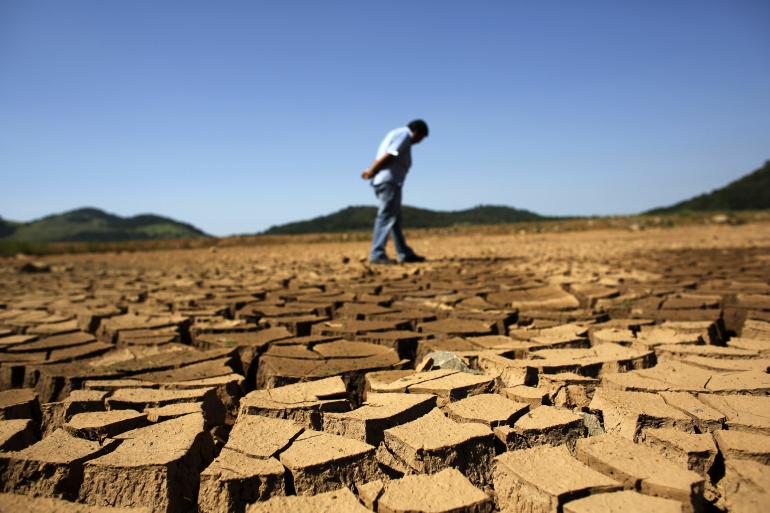
Drought in Brazil
But the drought and its effects are not limited to the cities. Brazil produces a third of the coffee in the world and forty-four percent of the Arabica coffee. A Brazil drought drives Arabica prices higher. Arabic coffee futures are up on expectations of a smaller harvest in Brazil according to the Wall Street Journal.
Coffee futures prices surged more than 4% to the highest level in four months on Tuesday, as dry weather in Brazil raised worries that the world’s biggest grower would reduce the next harvest. Arabica-coffee prices have gained 89% this year as Brazil’s worst drought in decades hurt the development of coffee cherries, prompting growers, exporters and other industry members to slash their estimates for the current crop.
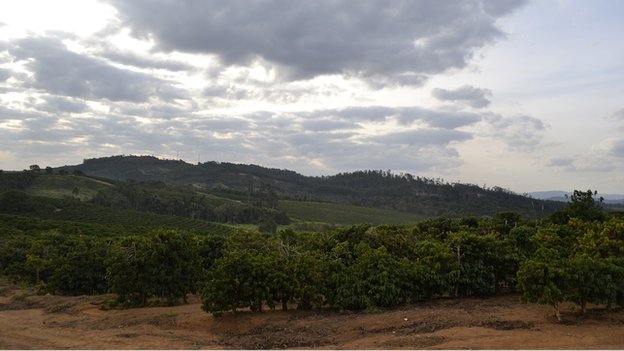
Parched Landscape in Brazil
USDA Report
The USDA Coffee Update from June 2014 forecasted a rise in coffee prices due to the drought in Brazil.
World coffee production for 2014/15 is forecast to decline 1.5 million bags from the previous year to 148.7 million due primarily to a weather related shortfall in Brazil. However, the reduction is expected to be partially offset by rebounding production in Colombia and Central America. Global bean exports and consumption are forecast at record levels, drawing inventories down.
The good news for lovers of Colombian organic coffee brands is that Colombian production is likely to be up. The bad news is that coffee leaf rust, la roya, has ravaged crops in Central American nations like Nicaragua. The other bad news is that your cup of organic coffee is likely to be more expensive in the coming year. A large part of this is the fact that growers in Central America are spraying heavily to protect their plants against the leaf rust. This will remove substantial quantities of beans from the organic category.

Drought Damages Brazil Coffee Crop
When Will Retail Prices Rise?
There are already price increases by Starbucks and Folgers but these folks buy early and have prices set by contract in advance. However, as the supply of good quality Arabica coffee dwindles, prices are likely to go a lot higher in the next year. Although Colombian production is likely to be back up by 2 million bags to around 12 million bags, Brazil will likely see its production fall by 5 million bags to around 33 million. (These are 60 kg = 132 pound bags of coffee beans.) As Brazil drought drives Arabica prices higher it will likely drive the price of organic Arabica beans much higher. Maybe it is time to buy green organic Arabica beans from Colombia and stock up!